
Tow Bars 101:
Become the Genius Customers Think You Already Are
Raymond Padgett
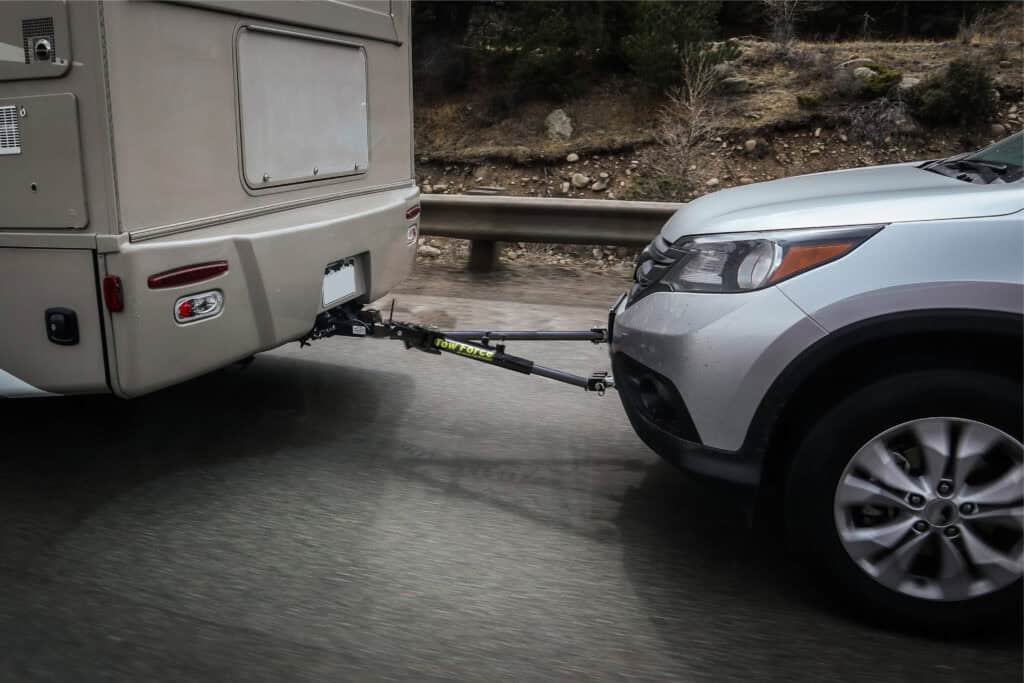
Welcome to the world of tow bars — the secret weapon of every serious motorhome owner, and the product category that turns “I think I need something to tow my Jeep” into “Wow, that dealership really knows their stuff.”
This training will make you faster, sharper, and more confident at the parts counter. You’ll learn how to diagnose customer needs in seconds, recommend the right tow bar without sweating, and close sales that stick (no returns, no headaches, no “my buddy said…” drama).
What This Training Will Do for You (Besides Make You Unstoppable)
By the end of this program, dealership personnel will be able to:
· Understand what tow bars do, who buys them, and why the category is important
· Diagnose customer needs quickly using simple, repeatable rules
· Explain features in ways your customers will understand.
· Recommend the right SKU instantly using fitment logic
· Handle objections like a pro — price, DIY, brand loyalty, all of it
· Identify upsell and cross‑sell opportunities that boost ticket size
· Merchandize tow bars so they actually move instead of collecting dust
Put it all together and you’ll see higher margins, faster sales, fewer returns, better customer satisfaction and more repeat business.
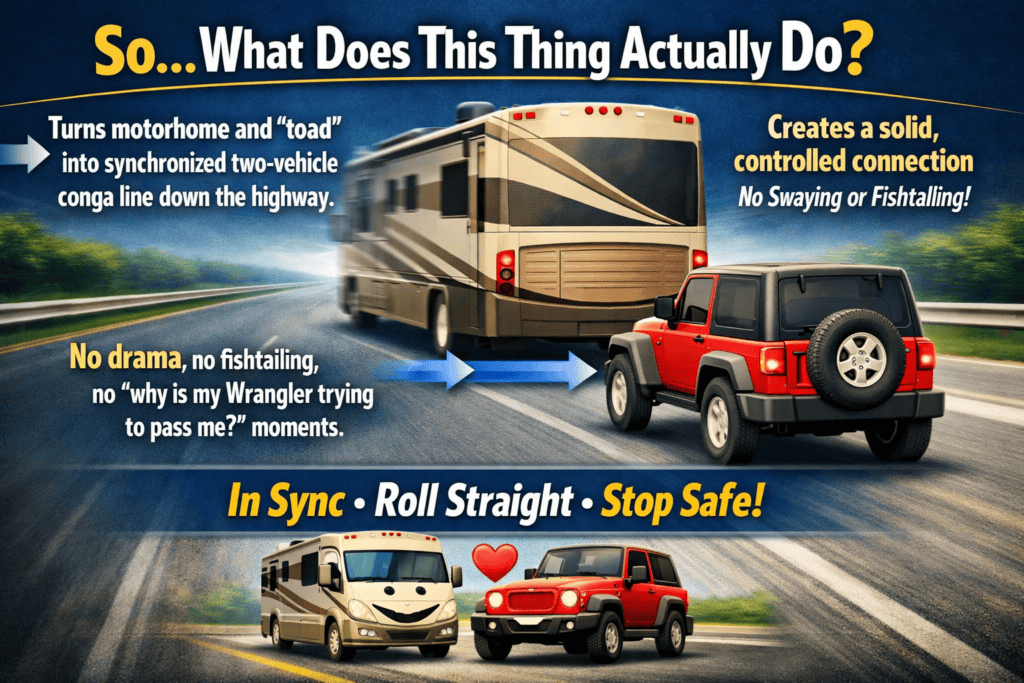
So… What Does This Thing Actually Do?
A tow bar does one beautifully simple thing: it turns your customer’s motorhome and their “toad” (the vehicle they want to tow) into a perfectly synchronized two‑vehicle conga line down the highway. No drama, no fishtailing, no “why is my Wrangler trying to pass me?” moments. It creates a rigid, controlled connection between the motorhome and the towed vehicle so both roll straight, stop safely, and behave like they actually like each other.
Because nobody wants to drive their 38‑foot Class A into a grocery store parking lot.
But here’s the part customers never understand: a tow bar isn’t just a metal stick that “pulls stuff.” It’s a precision‑engineered system that absorbs stress, manages articulation, prevents binding, and keeps the toad tracking perfectly behind the RV — even on uneven terrain, angled campsites, or those “creative” back‑in attempts RVers swear they didn’t need help with. A good tow bar makes hookup easy, disconnect painless, and towing smooth enough that the driver forgets they’re dragging 12,000 pounds behind them.
Customer Headaches: Identified, Diagnosed, and Solved by You
Most tow‑bar sales start the moment someone buys a motorhome. As soon as they realize they don’t want to drive their RV to the grocery store, they’re faced with a choice: flat tow with a tow bar or haul their vehicle on a tow dolly.
Tow bars and tow dollies both let RVers bring a second vehicle along for the adventure, but they do it in totally different ways — and customers almost never understand the difference until you break it down for them. A tow bar flat‑tows the vehicle with all four wheels on the ground, creating a clean, direct, rigid connection between the RV and the toad. It’s lighter, easier to store, quicker to hook up, and delivers a smoother, more natural towing experience. A tow dolly, meanwhile, lifts the front wheels of the vehicle onto a small trailer. It’s bulkier, heavier, harder to store, and requires more steps (and more patience) to load and secure the vehicle.
Outside of a motorhome sale, every tow‑bar sale starts the same way: with a customer walking in carrying a headache the size of a Class A motorhome. They’re frustrated, confused, overwhelmed, or convinced their buddy’s “expert advice” is gospel. Your job? Turn that chaos into clarity — fast. This section breaks down the most common tow‑bar problems customers bring to your counter and shows you exactly how to diagnose them like the dealership hero you are.
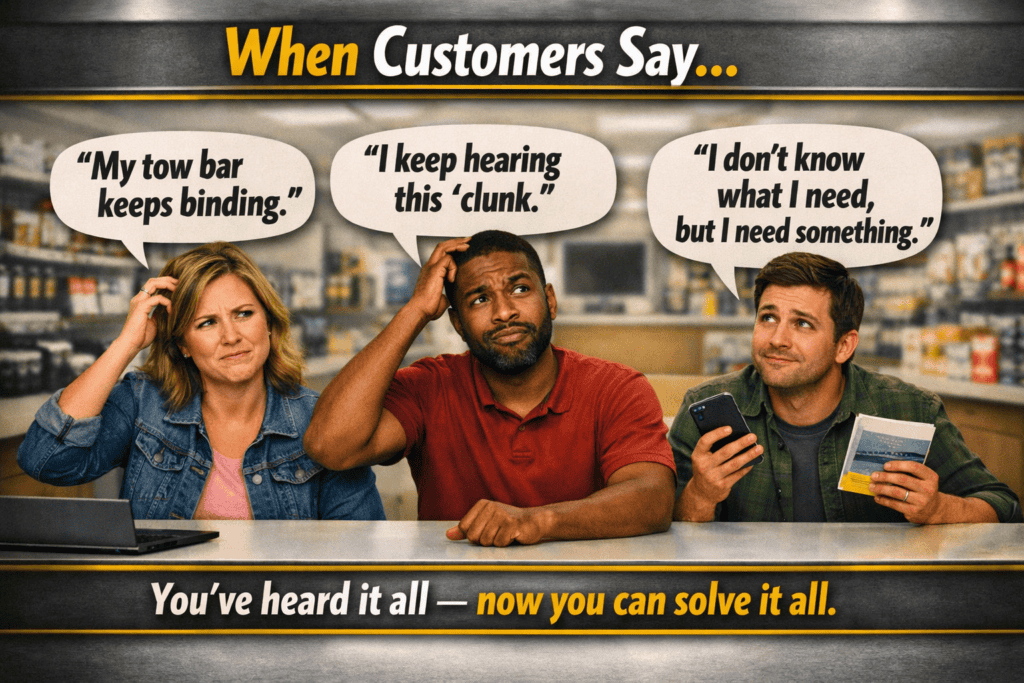
· First up, binding and stiff arms: The #1 complaint in the tow‑bar universe. Customers describe it like the tow bar is personally out to ruin their weekend. “It won’t disconnect,” “I had to rock the Jeep back and forth,” “I almost threw the thing in a lake.” These are classic signs of a bar without non‑binding arms or one that’s worn out. You get to be the genius who says, “Yep, that’s normal for older designs — here’s the upgraded version that fixes all of that.”
· Then there’s the mystery clunk: A sound customers swear is either the motorhome falling apart or the Jeep trying to escape. Spoiler: it’s usually worn bushings, loose connections, or a tow bar that’s simply not rated for the weight they’re pulling. You diagnose it in seconds by asking what they’re towing, how often, and what brand they’re using. They think you’re psychic. You’re not — you’re trained.
· And of course, the classic “I don’t know what I need, but I need something”: This is the customer who’s been Googling for three days and is now more confused than when they started. They expect you to know the difference between 8K and 12K ratings, which base plates fit their Wrangler, and why their neighbor’s setup looks different. You guide them through it with simple questions, clear explanations, and a recommendation that actually makes sense.
By identifying the headache, diagnosing the real issue, and offering the right solution, you turn frustration into relief, confusion into confidence, and walk‑ins into loyal customers who trust you for every future upgrade.
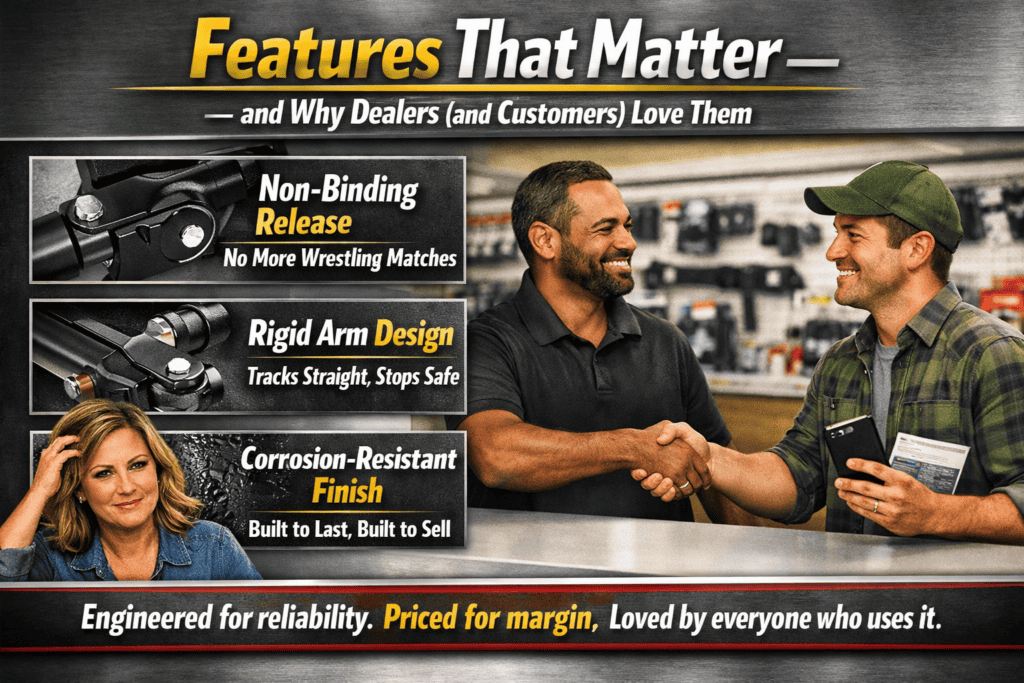
Features That Matter — and Why Dealers (and Customers) Love Them
Tow bars may look simple at first glance, but the features built into a good one are exactly what separate smooth, drama‑free towing from “why is my Jeep trying to fight me?” moments. These features aren’t just engineering details — they’re sales tools, profit drivers, and customer‑happiness machines.
· Non-Binding Arms: The single greatest invention since the cupholder. Customers love them because they make hookup and disconnect effortlessly, even on uneven ground. Dealers love them because they eliminate the #1 complaint in the tow‑bar world: “I can’t get this thing off!” Fewer headaches for the customer means fewer returns for you — and that’s a win on both sides of the counter.
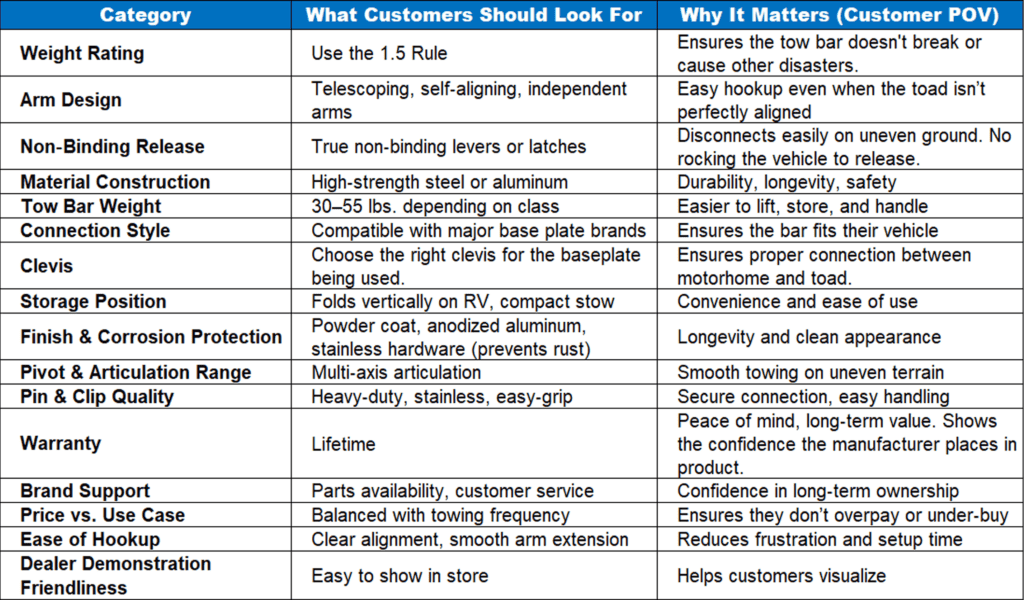
· Weight Ratings: To choose the right tow‑bar weight rating, start with the vehicle’s curb weight. Curb weight reflects what the vehicle actually weighs sitting on the lot, without passengers, cargo, or imaginary bowling balls. Once you have that number, apply the 1.5 safety rule: multiply curb weight by 1.5 to account for tight turns, uneven terrain, accessories, fuel, and real‑world stress (for example, a 4,500lb vehicle × 1.5 = 6,750lbs, then round up to the next tow‑bar class).
· Base plate compatibility: The perfect rating is useless if the tow bar doesn’t match the mounting system; if the customer already has a base plate, stick with the same brand or a proven adapter.
· Warranty: It is the clearest signal of how much confidence a manufacturer has in their tow bar. Some brands back their bars with lifetime coverage — and that tells you everything you need to know. Whenever possible, choose a tow bar with a lifetime warranty.
Here is a complete checklist that you and/or your customer should use when purchasing a tow bar.
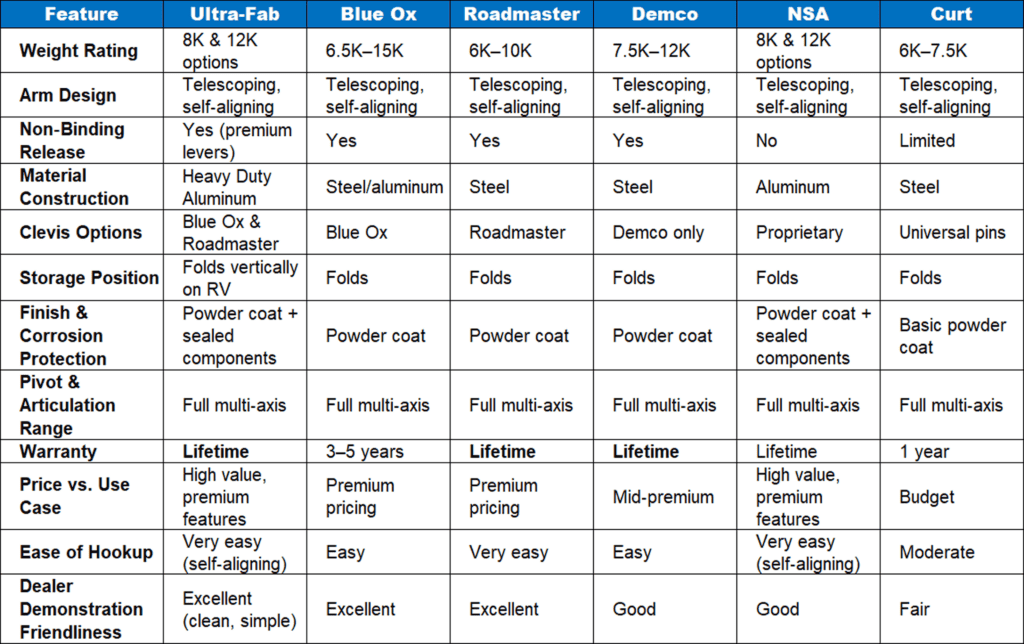
The Ultra‑Fab Advantage: Built for the Road, Backed for Life
As you can see from the chart Ultra-Fab has all the great benefits of other name brand tow bars and cap with a full lifetime warranty.
Ultra‑Fab tow bars aren’t just built to tow — they’re built to outlast the road, the weather, the miles, and anything an RV lifestyle can throw at them. Every bar starts with heavy‑duty aluminum, over‑engineered pivots, and true non‑binding arms that make hookup and disconnect smooth, even when the campsite isn’t. The design is simple on purpose: fewer moving parts, fewer failure points, and a towing experience that feels solid, predictable, and confidence‑inspiring.
But the real advantage is what happens after the sale. Ultra‑Fab backs every tow bar with a lifetime warranty, a statement that says, “We built this to last — and we’re willing to stand behind it forever.” Dealers get a product that sells itself with reliability and ease of use, and customers get a tow bar that feels like a long‑term investment instead of a temporary solution. Stronger construction, smoother operation, and support that never expires — that’s the Ultra‑Fab advantage.
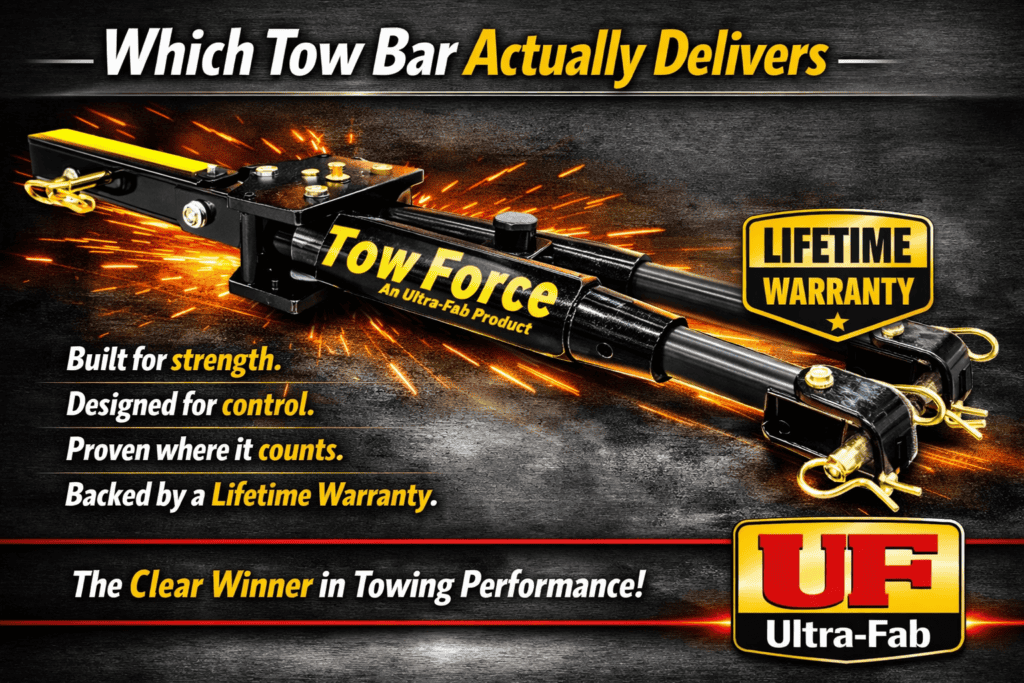
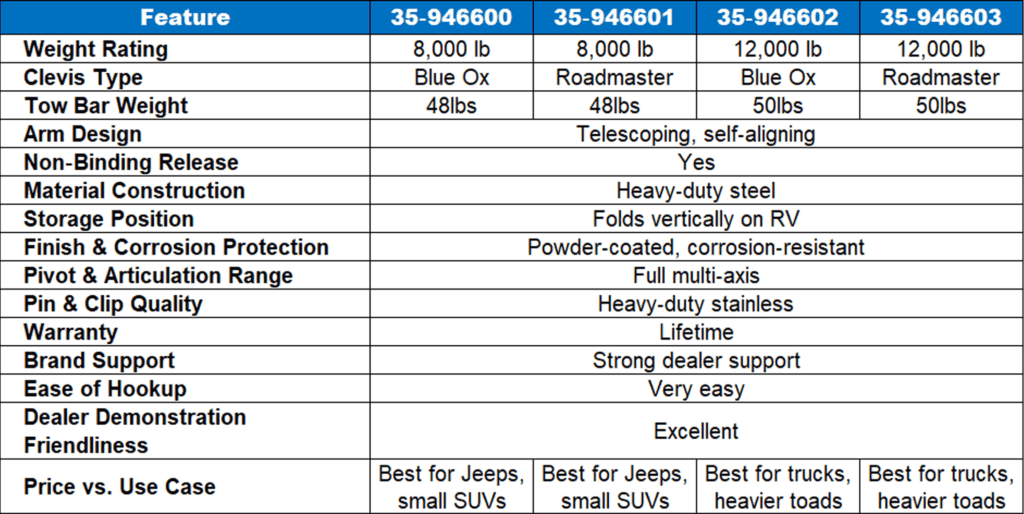
Find the Right Bar Fast: Your Fitment & SKU Selector
Ultra‑Fab’s tow‑bar lineup is intentionally simple, making fitment fast and frustration‑free for both dealers and customers. Here is a chart that makes determining the right Ultra-Fab tow bar for your customer.
How to Sell It: Live Counter Conversations
Selling a tow bar isn’t about memorizing specs — it’s about navigating the real, messy, wonderfully unpredictable conversations that happen at the parts counter every day. Customers walk in with half‑formed questions, bad advice from a buddy, or a problem they can’t quite explain. These live counter conversations drop you into realistic scenarios. You’ll see how to guide the discussion, simplify the decision, build trust fast, and close the sale without feeling pushy. Think of this as your playbook for sounding like the most knowledgeable, helpful person in the room — because you will be.
· The “I Just Need a Tow Bar” Customer
o Customer: “I just need a tow bar. What do you recommend?”
o You: “If you want something that’s easy to hook up, won’t bind on uneven ground, and is backed for life, Ultra‑Fab is the one to go with. Their arms self‑align, so you don’t have to fight with the vehicle to get it connected, and the non‑binding release means you’re not kicking or rocking the toad to disconnect. Plus, they’re built from heavy‑duty aluminum and come with a lifetime warranty — most brands don’t offer that. What are you towing? I’ll match you to the right weight class.”
· The “I Already Have a Base Plate” Customer
o Customer: “I already have a Blue Ox/Roadmaster base plate. What tow bar works with it?”
o You: “Perfect — Ultra‑Fab makes dedicated versions for both. If you’ve got a Blue Ox plate, the 35‑946600 or 35‑946602 will drop right in. If it’s Roadmaster, the 35‑946601 or 35‑946603 is your match. Same heavy‑duty construction, same non‑binding arms, same lifetime warranty — you just pick the clevis that fits your setup. What’s the curb weight of your toad? I’ll get you into the right capacity.”
· The “I Tow a Heavy Vehicle” Customer
o Customer: “I’m towing a truck. What do I need?”
o You: “For anything with real weight behind it, you want Ultra‑Fab’s 12K tow bar — either the 35‑946602 or 35‑946603 depending on your base plate. They’re built for heavy loads, with reinforced arms and pivots designed to handle the stress of tight turns and uneven terrain. And because Ultra‑Fab has a lifetime warranty, you know they built it to last. What’s the curb weight of your truck? I’ll make sure you’re in the right class.”
· The “I Want Something Easy to Use” Customer
o Customer: “I just want something simple. I don’t want to fight with it.”
o You: “Then Ultra‑Fab is exactly what you want. The arms telescope and self‑align, so you don’t have to back up perfectly straight. And the non‑binding release means you can disconnect even when the ground is uneven — no kicking, no rocking, no swearing. It’s one of the easiest tow bars to use, especially for solo travelers. Let me show you how the release handles work — this is what customers love most.”
Real‑World Objection Responses That Close Deals
Every sale has a turning point — that moment when the customer hesitates, pushes back, or throws out the classic “I saw it cheaper online.” When you know how to handle objections smoothly, you stop feeling like you’re defending a product and start sounding like the expert who’s simply guiding the customer to the right choice. This is where deals get saved, margins stay healthy, and you become the salesperson customers come back to.
Here are some of the most common objections and how you can handle them like the pro you are.
· Customer: “I saw a cheaper tow bar online.”
o You: “I get it — there’s always a cheaper option online. The difference is what happens when you actually use it. Ultra‑Fab gives you non‑binding arms, heavy‑duty aluminum, and a lifetime warranty. The cheaper bars bind, flex, or wear out, and then you’re buying twice. This is the one that works every time, at every campsite, without frustration.”
· Customer: “I don’t think I need a tow bar rated that high.”
o You: “Totally understandable — but tow bars aren’t like hitches. You always want extra capacity because tight turns, uneven ground, and real‑world stress add load you don’t see on paper. Ultra‑Fab’s 8K and 12K bars give you that safety margin built in”
· Customer: “I heard Blue Ox/Roadmaster is the only brand to buy.”
o You: “They’re good brands, no doubt — but Ultra‑Fab builds to the same premium standard, has true non‑binding arms, and backs the whole bar with a lifetime warranty. Plus, Ultra‑Fab makes versions that fit both Blue Ox and Roadmaster base plates, so you get the compatibility and the better value.”
· Customer: “I’m worried it’ll be hard to hook up.”
o You: “That’s exactly why Ultra‑Fab designed self‑aligning arms. You don’t have to back up perfectly straight — the arms telescope and lock automatically. And when you’re unhooking on uneven ground, the non‑binding release means no kicking, rocking, or fighting with it. It’s one of the easiest tow bars to use, especially for solo travelers.”
Upsells That Make You Money (and Make Customers Happier)
The best upsells never feel like upsells — they feel like solutions the customer didn’t know they needed. When someone buys a tow bar, they’re not just buying a piece of hardware; they’re buying safety, convenience, and confidence for every mile they tow. The right add‑ons amplify all three. And here’s the win‑win: every one of these recommendations boosts your ticket total while genuinely improving the customer’s setup. Here are some great add-ons:
· Base Plates: A tow bar is only as good as the base plate it connects to, which makes this one of the easiest and most logical upsells. Recommending the correct Blue Ox or Roadmaster style base plate ensures a perfect fit, smoother hookup, and a safer towing experience. When you position it as the foundation of the entire system — because it is — customers immediately understand the value.
· Tow Lights: Tow lights are the simplest safety upgrade you can offer, and they’re an easy yes for most customers. Whether they choose magnetic lights, plug and play diode kits, or a full wiring harness, proper lighting keeps them legal in all 50 states and ensures their toad communicates clearly with every brake tap and turn signal. Customers appreciate that this isn’t an “extra” — it’s a safety requirement that protects them from tickets, accidents, and roadside headaches.
· Braking Systems: A supplemental braking system is one of the highest value add ons you can recommend. It reduces stopping distance, protects the motorhome’s brakes, and is legally required in most states once the toad passes a certain weight. Framing it as a safety and compliance upgrade — not a luxury — makes the decision easy. Customers tow with more confidence, and you increase the ticket with a product that genuinely improves the entire setup.
· Hitch Risers/Drops: Most customers don’t realize their tow bar needs to sit level to perform correctly. A riser or drop is the quick, inexpensive fix that prevents binding, uneven wear, and dangerous towing angles. When you show them how a simple height adjustment protects their investment and makes hookup smoother, it becomes one of the easiest cross sells in the entire towing category.
· Storage Covers: A storage cover is the small add on that pays off big for the customer. It protects the tow bar from UV damage, road grime, and weather exposure, extending the life of the arms and pivots. Customers love that it keeps their equipment looking new, and you get a simple, low friction upsell that pairs naturally with every tow bar purchase.
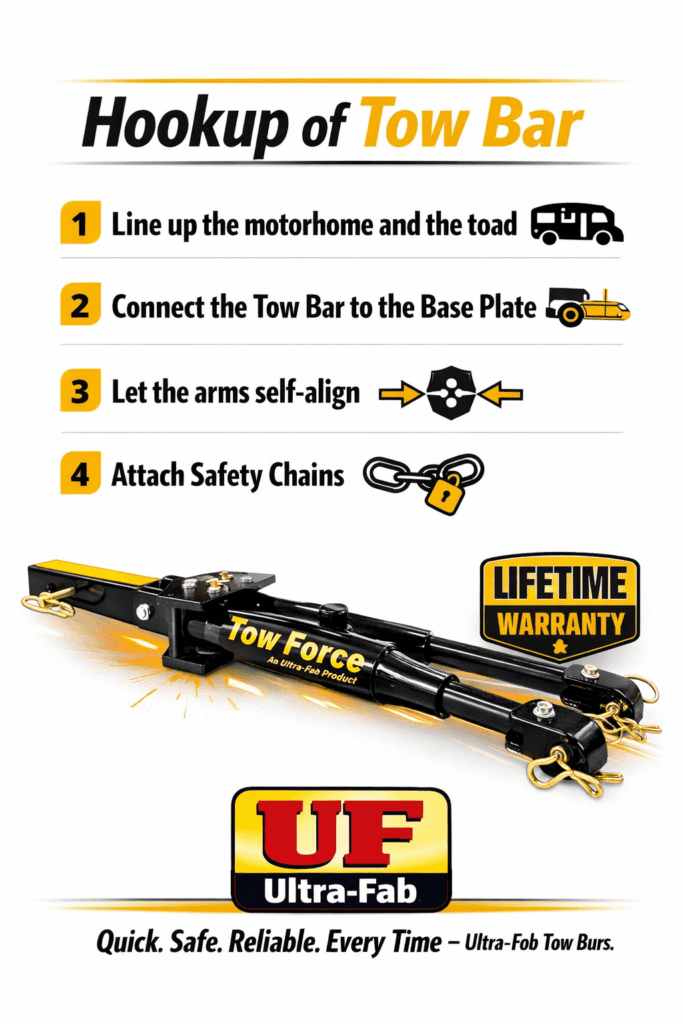
From Hookup to Disconnect: How It Actually Works
Tow bars may look simple, but the magic is in the sequence — and when you understand that sequence, you instantly become the dealership hero who can explain towing in a way customers actually get. —
Hooking Up
· Step 1) Line up the motorhome and the toad: It doesn’t have to be perfect. Not NASA‑level precision. Just “close enough that you’re not sideways in the parking lot.” Ultra‑Fab’s self‑aligning arms do the heavy lifting here — literally. They telescope, pivot, and lock automatically, which means the customer doesn’t need to back up with the precision of a fighter pilot.
· Step 2) Connecting the Tow Bar to the Base Plate: The Click That Sells It: Once the vehicles are close, the tow bar arms swing out and attach to the base plate tabs. The pins slide in, the clips lock, and boom — the customer feels like a towing genius. This is also where you remind them that Ultra‑Fab’s heavy‑duty aluminum and lifetime warranty mean they’re hooking up to something built to survive actual roads, not just showroom floors.
· Step 3) Let the arms self-align: Here’s the part customers love: as the RV pulls forward a few feet, the Ultra‑Fab arms extend, straighten, and lock automatically. No pushing. No pulling. No yelling at a spouse. No “just a little more… no, too far… stop!” Once the arms lock, the system is rigid, stable, and ready for the road.
· Step 4) Safety Chains: Tow Lights & Braking Systems: Hook up the safety chains, lights and braking system. Its not just the law, it’s the only safe way to tow. These aren’t extras — they’re what keep you legal, safe, and ticket‑free.”
Disconnecting (Reminder: Never back up with a tow bar attached. It will almost certainly damage the tow bar)
· Step 1) Before backing the motorhome in to the campsite, stop and prepare to disconnect the toad.
· Step 2) Push the handle. Arms release. You’re done.
· Step 3) Disconnect brake, lights, and safety cables.
· Step 4) Store tow bar, brake system, lights and safety cables.
· Step 4) Move the toad vehicle out of the way.
· Step 5) Move motorhome in position.
· Step 6) Move vehicle into position.
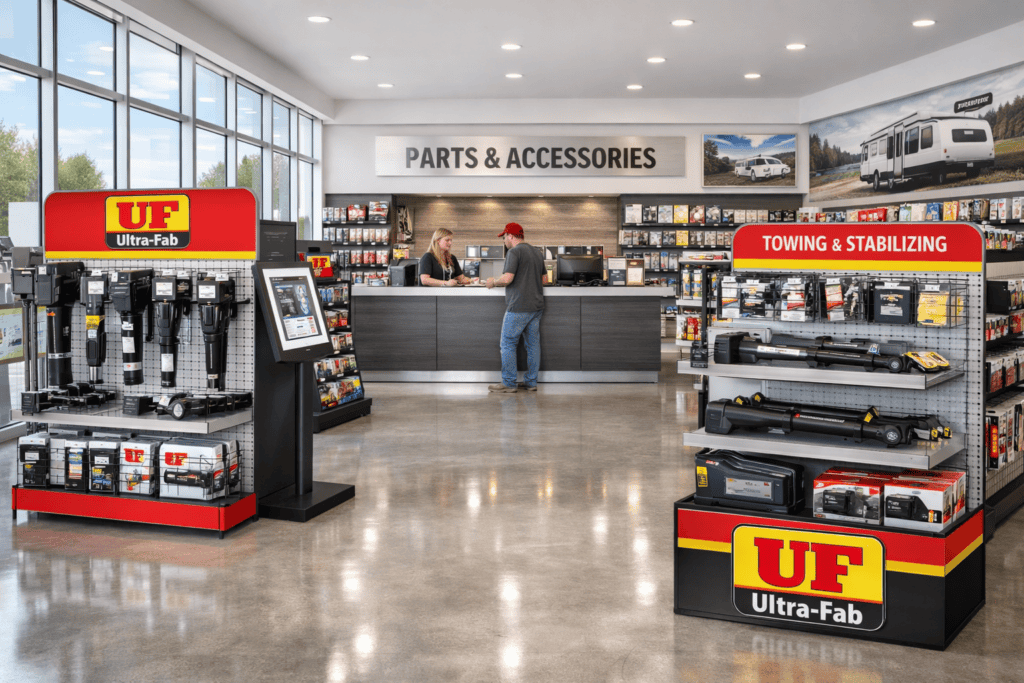
Visual Strategies That Drive Sales
Interactive displays turn a casual “I’m just looking” shopper into someone saying, “Oh wow… that’s actually really easy.” They shrink the learning curve, eliminate the fear factor, and build instant confidence—and in the RV world, confidence is what closes the sale. When customers can touch the tow bar, move the arms, and feel the engineering for themselves, Ultra‑Fab stops being a product on a shelf and becomes the obvious choice.
Your Ultra‑Fab interactive tow‑bar display should be the visual anchor of the towing section—the thing customers notice before anything else. The signage does the early heavy lifting, giving them quick, digestible info and opening the door for conversation. Place the display where traffic naturally flows, not hidden behind brake controllers or swallowed by the hitch wall. If customers can’t miss it, they can’t ignore it. And once they put their hands on it, they’re already halfway sold.
Ultra‑Fab tow bars shine the moment customers feel how the arms telescope, how smoothly the pivots move, and how effortlessly the non‑binding release handles operate. Train your team to invite interaction: “Try pulling the arm out—see how it locks itself? That’s why hookup is so simple.” The more customers play with the display, the more they understand the value. And the more they understand the value, the easier it is for your team to close the sale.
Buy any 3 Ultra-Fab tow bars and they will send the display to you at no charge.
Closing Thoughts: Sell the Brand That Makes You Look Good
At the end of the day, every product you choose to stock says something about your dealership. It tells customers what you value, what you stand behind, and what you’re willing to put your reputation on. Ultra‑Fab tow bars make that choice easy.
When you stock Ultra‑Fab, you’re not just filling shelf space—you’re choosing fewer returns, fewer headaches, and fewer “Hey, this thing won’t disconnect” conversations. You’re choosing a tow bar that impresses customers the moment they touch the interactive display. You’re choosing a brand that gives your team simple, powerful talking points that close sales without pressure. And you’re choosing a product line that builds trust, boosts ticket totals, and makes your dealership the place customers recommend to their friends.
Ultra‑Fab isn’t just another tow‑bar option. It’s the one that installs easier, operates smoother, disconnects cleaner, and keeps your customers happy long after they leave the lot. Stock it proudly. Sell it confidently. And enjoy being the dealership that always recommends the product that performs exactly the way you promised.
Ultra‑Fab Tow Bar Knowledge & Skills Assessment
This assessment is your chance to prove you’ve mastered the essentials — from diagnosing real‑world customer headaches to selecting the right Ultra‑Fab SKU with confidence. If you can answer these questions, you’re not just “familiar” with tow bars… you’re the dealership expert customers trust, coworkers rely on, and managers brag about. Let’s see what you’ve got.
1) A customer walks in frustrated and says, “My tow bar won’t disconnect unless I rock the Jeep back and forth.” What’s the REAL issue?
a. They forgot to unhook the safety chains
b. They’re using a tow bar without non‑binding arms
c. Their motorhome is parked on level ground
d. Their braking system is malfunctioning
2) A customer says, “I don’t know what I need, but I need something to tow my Wrangler.” What’s your BEST first step?
a. Ask what color their Wrangler is
b. Ask what their buddy recommended
c. Ask for the vehicle’s curb weight and base‑plate brand
d. Show them the most expensive tow bar
3) A customer complains about a loud “clunk” while towing. What’s the most likely cause?
a. Their RV is too long
b. Worn bushings, loose connections, or an underrated tow bar
c. Their tires are underinflated
d. They forgot to lock the arms
4) A customer has a Blue Ox base plate and a 4,500 lb toad. Which Ultra‑Fab tow bar fits?
a. 35‑946601
b. 35‑946602
c. 35‑946603
d. 35‑946600
5) A customer is towing a heavy truck and needs a 12K tow bar that fits a Roadmaster base plate. Which SKU is correct?
a. 35‑946600
b. 35‑946601
c. 35‑946602
d. 35‑946603
6) A customer already owns a Roadmaster base plate and wants an 8K Ultra‑Fab tow bar. Which SKU should you recommend?
a. 35‑946600
b. 35‑946601
c. 35‑946602
d. 35‑946603
7) What is the #1 customer complaint in the tow‑bar world?
a. Tow lights not working
b. Binding and stiff arms
c. Base plates rusting
d. Safety chains being too short
8) What is the correct formula for choosing the right tow‑bar weight rating?
a. Curb weight × 2
b. Curb weight ÷ 2
c. Curb weight × 1.5, then round up
d. Curb weight + 500 lbs
9) What is the biggest advantage of Ultra‑Fab’s non‑binding arms?
a. They make the tow bar lighter
b. They eliminate the need for safety chains
c. They allow easy disconnect even on uneven ground
d. They reduce the need for tow lights
10) Why does Ultra‑Fab’s lifetime warranty matter to dealers?
a. It increases the price
b. It reduces returns and builds customer confidence
c. It requires annual inspections
d. It only applies to certain parts
Answer Key
1. B — They’re using a tow bar without non‑binding arms
2. C — Ask for the vehicle’s curb weight and base‑plate brand
3. B — Worn bushings, loose connections, or an underrated tow bar
4. D — 35‑946600 (Fits Blue Ox at 8K)
5. D — 35‑946603 (12K Roadmaster‑style bar)
6. B — 35‑946601 (8K Roadmaster‑style bar)
7. B — Binding and stiff arms.
8. C — Curb weight × 1.5, then round up
9. C — They allow easy disconnect even on uneven ground
10. B — It reduces returns and builds customer confidence