
The PowerMover Advantage: Why Smart Dealers Never Use Forklifts Again
Raymond Padgett
Welcome to the Ultra‑Fab PowerMover Dealer Training Program—your new unfair advantage in the RV world. If you’ve ever watched your lot personnel try to muscle a trailer into position like they’re reenacting a scene from World’s Strongest Man, you already know why this article is going to matter. If you’ve ever witnessed them use a forklift to position trailers at a show, know that you may be called as a witness for the insurance company.
PowerMovers are one of those rare products where your pain should be obvious.
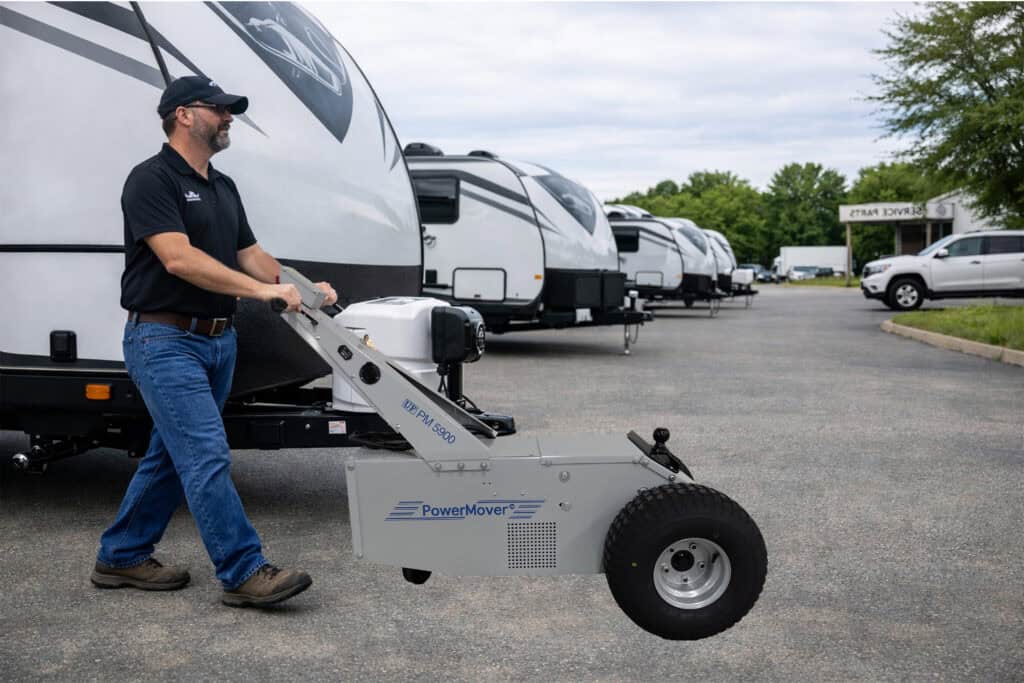
The solution is dramatic, and the dealership’s savings potential is downright beautiful.
This article is built to help you:
Identify the best way to move trailers on your lot or at shows
Understand the competitive landscape so you know the best product for your particular application
Recognize what (if any) add-ons are important for the way you will use the trailer mover
This isn’t a sale pitch (well, maybe a tiny bit). It’s a full‑scale dealer training system.
Stop Using Forklifts Like They’re Surgical Instruments
The category of powered trailer‑moving solutions—especially those designed for travel trailers and fifth wheels—is one of the most practical, problem‑solving, customer‑saving segments in the entire RV market. These products exist because modern RVs are bigger, heavier, and parked in tighter spaces than ever before. Whether it’s a 22‑foot travel trailer being tucked inside a repair bay or a 40‑foot fifth wheel being nudged into a tight space at a trade show, powered moving solutions transform a stressful chore into a controlled, predictable process.
Many dealers use forklifts to make these maneuvers, but they lack precision needed for tight situations and they create bounce that damage jacks and sometimes the trailers themselves.
When you’re talking tight spaces, Ultra-Fab PowerMovers become indispensable.
Stop Wrestling Trailers—Start Commanding Them
Ultra‑Fab PowerMovers take one of the most frustrating, nerve wracking, tasks in the RV world—moving a trailer—and turn it into a smooth, controlled, almost effortless experience. These compact, high‑torque, motorized units are engineered to move travel trailers, cargo trailers, and even fifth wheels and gooseneck trailers with precision that tow vehicles and forklifts simply can’t match. In short, Ultra‑Fab PowerMovers give dealers the ability to maneuver thousands of pounds with the finesse of a remote‑control toy… except the “toy” weighs as much as a small elephant.
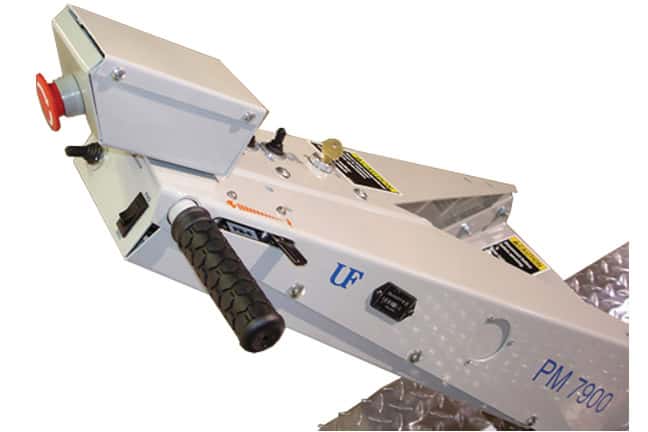
At their core, Ultra‑Fab PowerMovers provide powered, directional control over trailer movement. Instead of pushing, pulling, rocking, or praying, your people use a handle control to guide trailers exactly where it needs to go. The motor does the heavy lifting, the gearing provides the torque, and the operator simply walks alongside the trailer as it glides into position.
Tow vehicles are great for highways, but they’re terrible at threading needles. Forklifts
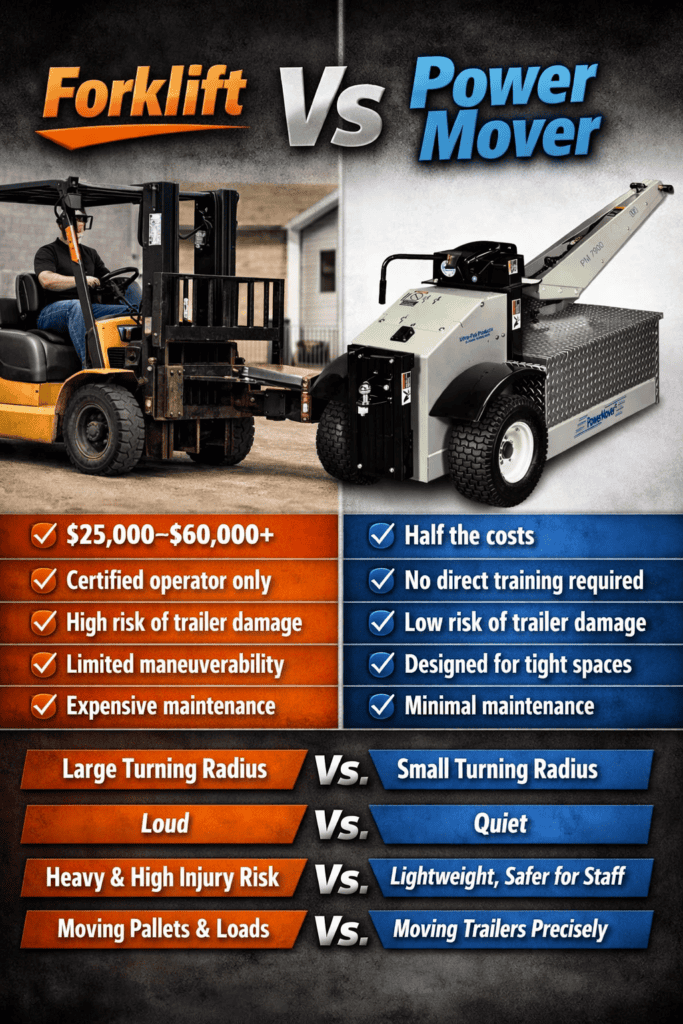
can move trailers, but they bounce, jerk, and create the kind of shock loads that bend jacks, damage supports and end trailer frames. Ultra‑Fab PowerMovers solve these problems by delivering slow, controlled, directional movement that allows the operator to make micro‑adjustments in real time.
Ultra‑Fab PowerMovers are built to handle serious weight. With models capable of moving up to 25,000lbs, they’re ideal for everything from lightweight utility trailers to full‑size fifth wheels. The high‑torque motor provides the grunt needed to overcome friction, slopes, and uneven terrain, while the gearing ensures smooth, controlled movement instead of sudden jumps or stalls.
In short: Ultra‑Fab PowerMovers turn trailer moving from a chore into a superpower.
Everything Your Dealership Wishes Forklifts Could Do
Ultra‑Fab PowerMovers are packed with features that don’t just look good on a spec sheet—they translate directly into smoother operations for your dealership. This section breaks down each major feature, shows what it means to your dealership.
High‑Torque, Industrial‑Grade Motors: Ultra‑Fab PowerMovers use high‑torque motors capable of moving up to 25,000lbs (depending on model) with controlled, steady force.
Precision Directional Control: Ultra‑Fab movers offer slow‑speed, micro‑adjustable directional control that tow vehicles and forklifts simply cannot match.
Stop Damaging Tongue Jacks: Your staff can maneuver trailers inside service bays, showrooms, and tight dealership lots without damaging jacks, bumping inventory, or scraping walls. This saves time, reduces risk, and makes your dealership look more professional.
Universal: Works on all known brands and makes of travel trailers, cargo trailers, enclosed trailers, fifth wheels and gooseneck trailers.
Heavy‑Duty Construction & Reliability: Ultra‑Fab PowerMovers are built with reinforced frames, durable gearing, and components designed for daily dealership use. You get a product that holds up under repeated use, meaning fewer warranty claims and fewer “this broke after two uses” conversations. Your staff can rely on it for internal trailer movement.
Ergonomic, User‑Friendly Controls: Simple, intuitive handle controls make operation easy for anyone on your team or any customer who buys one.
Compact Footprint & Easy Storage: Ultra‑Fab movers are compact enough to store in service bays. They take up considerably less room than a forklift.
The High‑Stakes Checklist: What Dealers MUST Evaluate Before Buying a PowerMover
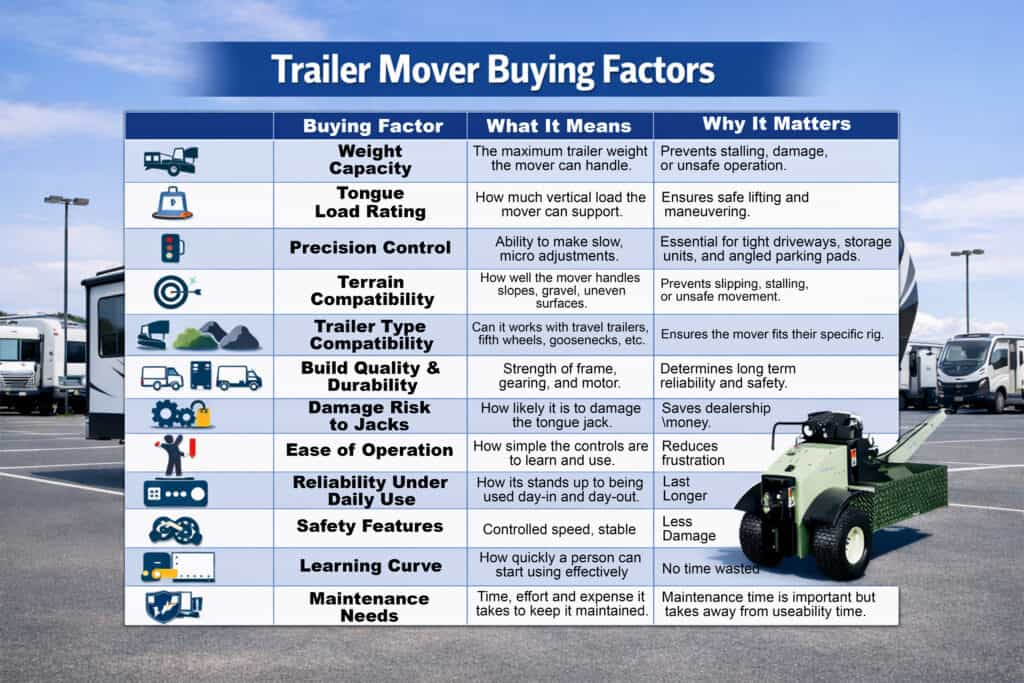
When a dealership is choosing a powered trailer‑moving solution, the stakes are high: safety, efficiency, jack damage, staff training time, and even the dealership’s professional reputation all hinge on picking the right tool. Not all movers are built for the daily abuse of service bays, tight showroom maneuvering, or the sheer weight of modern fifth wheels and goosenecks—and the wrong choice can lead to bent jacks, frustrated technicians, and expensive mistakes. This chart isolates the critical points when choosing the right mover.
With modern travel trailers, fifth wheels, and goosenecks getting heavier and storage spaces getting tighter, your staff needs equipment that delivers precision, reliability, and zero‑damage maneuvering every single time. Not all movers are built for the daily abuse of dealership environments, and picking the wrong one can lead to bent jacks, frustrated technicians, damaged inventory, and costly downtime. To help you make the smartest, safest, and most profitable choice, the chart below breaks down the critical buying factors and shows exactly how different brands stack up—and the old forklift workaround that causes more problems than it solves.
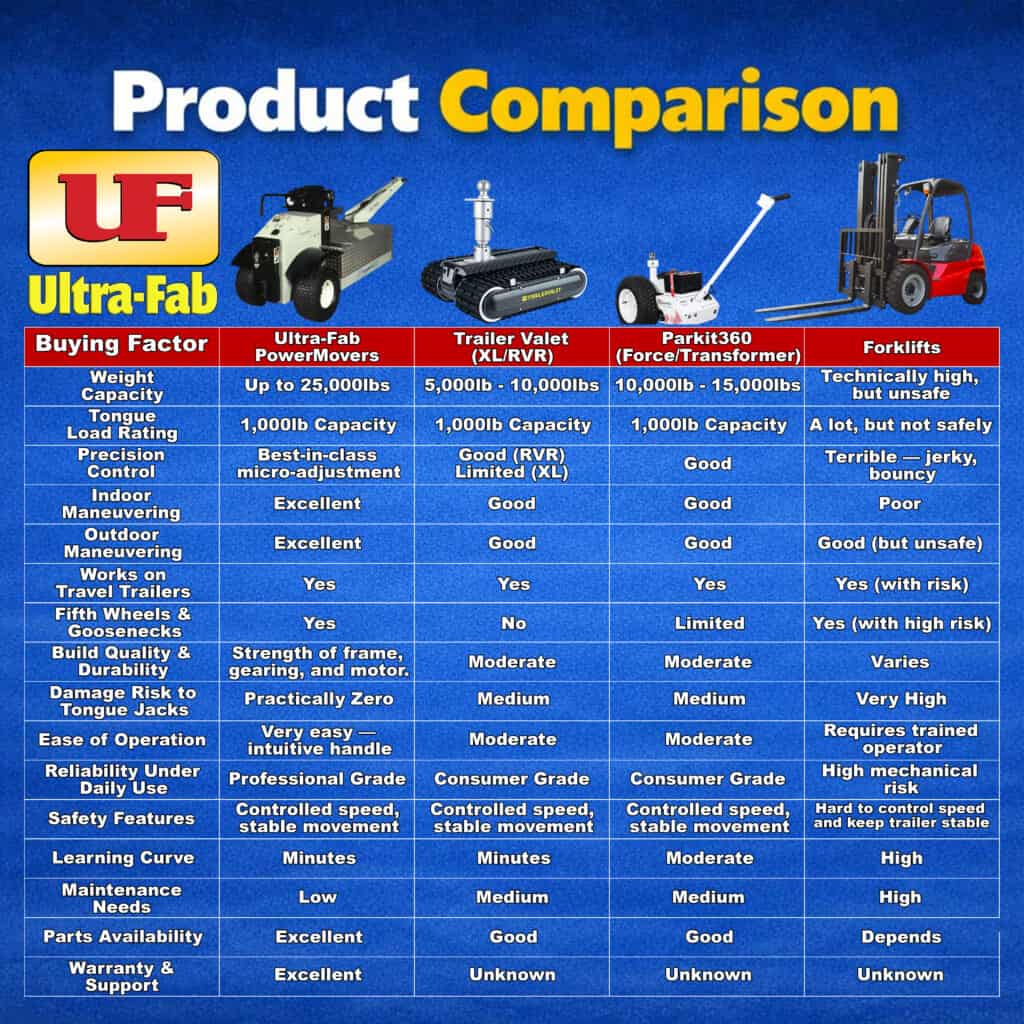
This chart makes the truth impossible to ignore: Ultra-Fab’s PowerMovers outperform every competitor in every category that actually matters to a professional RV dealership. While consumer‑grade movers tap out at 5,000lbs–15,000lbs, Ultra‑Fab pushes up to a massive 25,000lbs with controlled, predictable force—giving dealers the ability to move everything from lightweight cargo trailers to full‑size fifth wheels and goosenecks without hesitation. Precision control is where Ultra‑Fab completely separates itself from the pack: slow‑speed micro‑adjustments, zero jack bounce, and stable maneuvering make it the only solution truly built for tight service bays, showroom positioning, and trade‑show environments. Competitors can “manage,” but Ultra‑Fab masters the job.
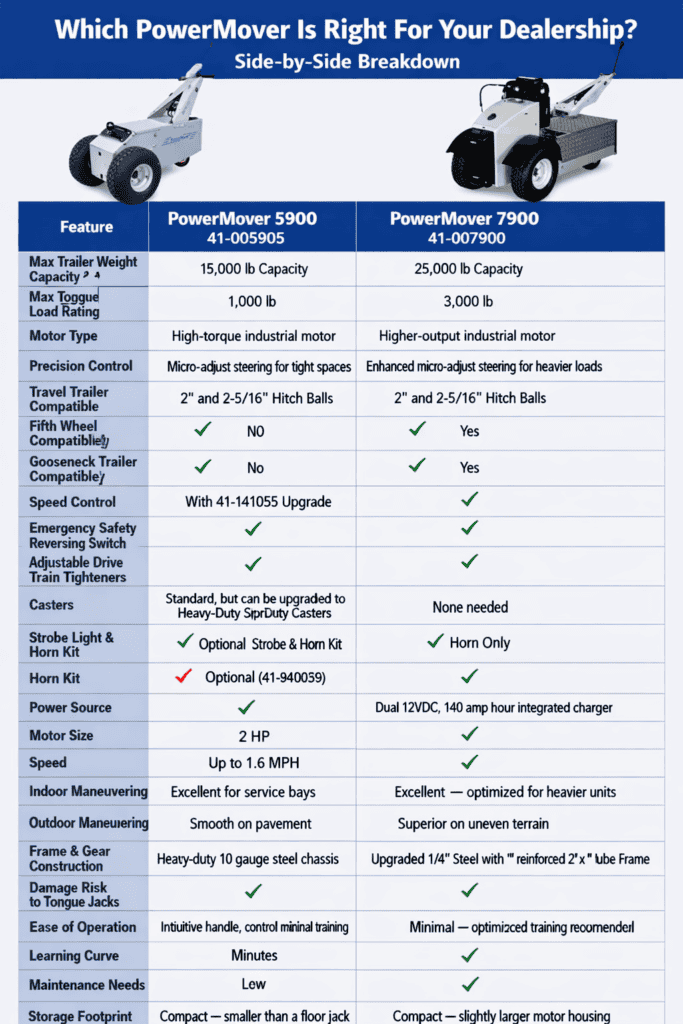
So, let’s dial it in. Here are the two available models of Ultra-Fab PowerMovers. Compare their features to help you choose the perfect model for your application.
Unlock the Full Potential of Your PowerMover With These Upgrades
Ultra‑Fab’s PowerMover is already a workhorse—built to push, pull, and position trailers, cargo rigs, and equipment with precision. But the real magic happens when you pair it with the right upsell items. These accessories don’t just “add features”; they transform the PowerMover into a fully customized, job‑specific machine that handles heavier loads, tougher terrain, and more demanding environments. Here is a deep dive into each accessory item and how it elevates the PowerMover from capable to unstoppable.
Weight Kit, 224lb (41‑001040): The foundation of serious traction. Add to your PM5900. When you’re moving heavier trailers or dealing with uneven surfaces, weight becomes your best friend. This kit adds downward force directly over the drive wheels, dramatically improving grip and reducing wheel slip. For those that regularly move travel trailers, fifth wheel trailer, enclosed trailers, equipment haulers, or anything with stubborn tongue weight, the 224lb kit is the difference between “it works” and “it works effortlessly.”
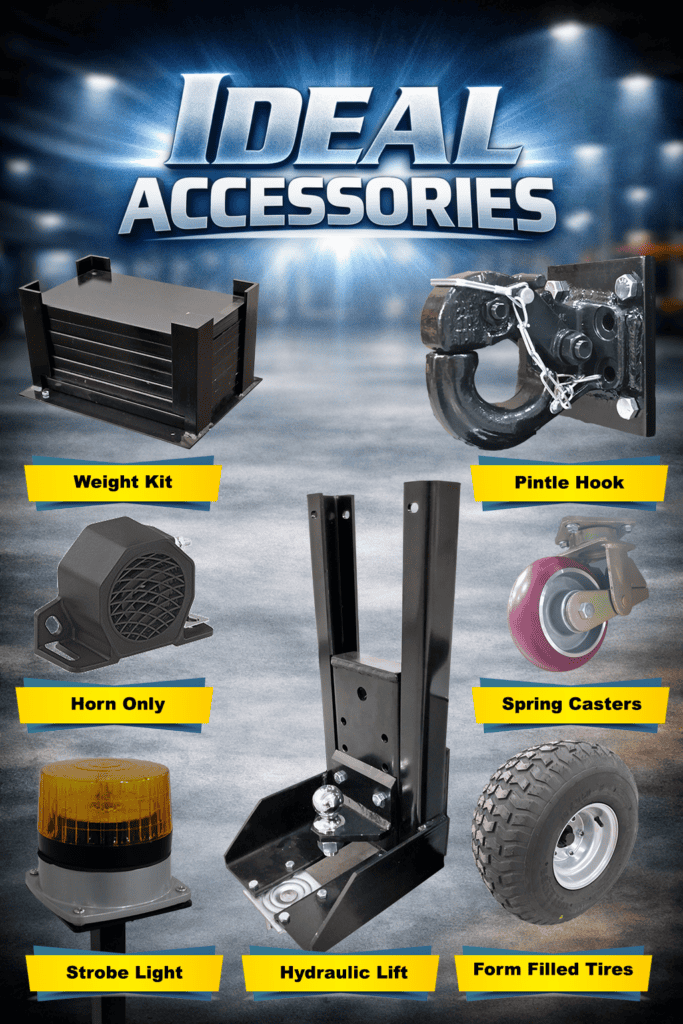
Pintle Hook Attachment (41‑013682): Expand the PowerMover’s versatility beyond standard couplers. Pintle systems are common in commercial, agricultural, and industrial environments because they handle extreme articulation and heavy-duty loads. Adding this attachment allows the PowerMover to connect to work trailers, military-style lunette rings, and specialty rigs. It opens the door outside the traditional RV space—contractors, landscapers, fleet operators, and municipal buyers.
Heavy-Duty Spring Caster (41‑500110): When you want stability and maneuverability. When moving weighty loads, the PowerMover’s front end can experience bounce or uneven tracking. The spring caster absorbs shock, maintains consistent ground contact, and smooths out directional changes. This is especially valuable on gravel, cracked pavement, or shop floors with transitions. It’s a small upgrade that delivers a big improvement in control.
Foam Filled Tires (41‑500125 Upgrade or 41-880009 Add-On when purchasing a new PowerMover): The durability upgrade that eliminates flats entirely. Foam-filled tires maintain consistent shape, resist punctures, and perform reliably in environments with debris, metal shavings, or rough terrain. For customers who use the PowerMover in warehouses, construction sites, or outdoor yards, this is a must-have. It’s great for users who simply want “no maintenance, no surprises.” Use item # 41-880009 to upgrade the PM5900 to foam filled tires (PM7900 has them as standard equipment. Use 41-500125 for replacements and/or to upgrade a PowerMover you have already purchased.
Hydraulic Lift (41‑800125 Hydraulic Lift): The premium upgrade for the PM5900. It allows the operator to raise and lower the trailer tongue or attachment point with hydraulic assistance, reducing strain and improving precision. This is ideal for those that frequently switch between trailers or need fine control when aligning hitches. It turns the PowerMover into a true one-person positioning system. Hydraulic Lift comes standard on PM7900.
Safety Add-Ons (41‑940439 Horn Kit and 41‑810050 Strobe Light & Horn): The horn provides audible alerts in busy yards or warehouses, while the strobe light adds high-visibility signaling for nighttime or low-light operations. These upgrades are perfect for everyone and essential for those that need to meet workplace safety requirements. Strobe Light & Horn kid is available for PM5900 (41-005905). Horn Kit is available for PM7900 (41-007900).
Mastering the PowerMover: The Art of Making Trailers Behave
Operating an Ultra‑Fab PowerMover starts with the golden rule of dealership life: control the trailer, don’t let the trailer control you. The PowerMover is designed to give you precision movement in tight spaces, crowded lots, uneven gravel, and those “why did the customer park it like that?” situations. Before you even touch the throttle, make sure the unit is on level ground, the tires are clear of debris, and the attachment point is aligned with the trailer coupler or pintle ring. A
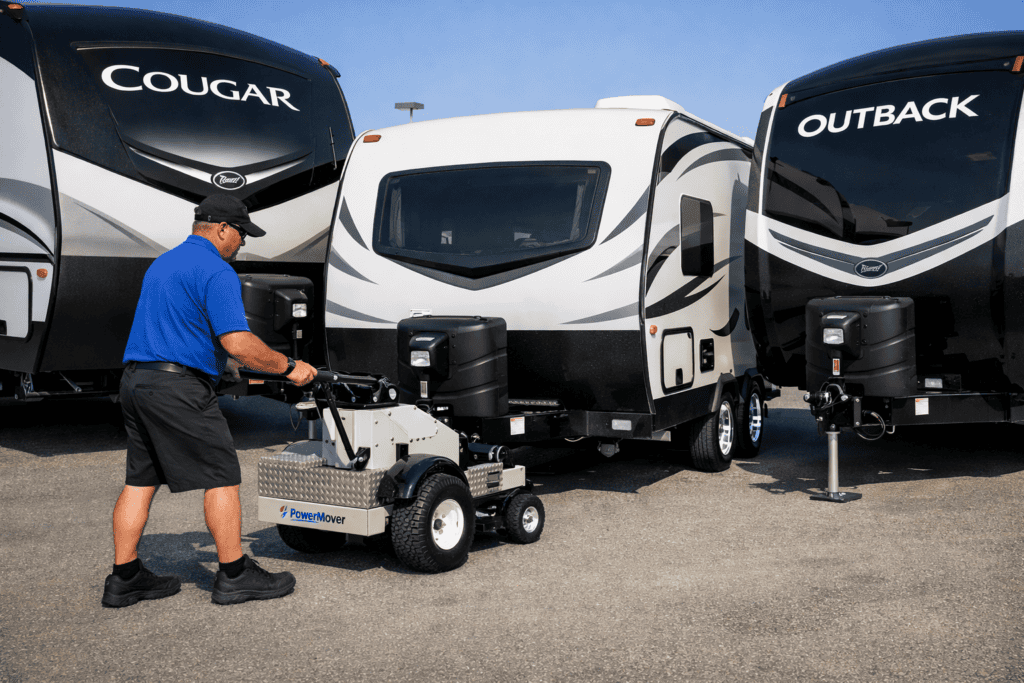
clean start equals a clean move.
Once aligned, lower the PowerMover’s hitch post or pintle attachment into position. Lock the coupler, secure the latch, and give the trailer a little shake—just enough to show dominance. Now you’re ready to power up.
Engage the PowerMover’s drive system with a smooth throttle pull. This isn’t a drag race; it’s controlled torque. The machine delivers steady, predictable power, allowing you to creep forward, pivot, or back into tight spaces with surgical accuracy.
As you move, keep your eyes on the trailer wheels and your hand on the throttle. The PowerMover responds instantly, giving you the ability to make micro‑adjustments that forklifts and tow vehicles simply can’t match. This is where the PowerMover shines—effortlessly snaking a 35‑foot trailer between two units without breaking a sweat. It’s part demonstration, part flex.
Turning is where the PowerMover earns its reputation. The unit pivots around its drive wheels, allowing tight-radius turns that make even the most stubborn trailers behave. If you’re operating a PM5900 or PM7900 with foam-filled tires, traction stays consistent even on gravel or cracked pavement. If you’ve got the weight kit installed, you’ll feel the difference immediately—more grip, less slip, and zero drama.
When backing into a display spot, use short throttle bursts and small steering corrections. Once positioned, release the throttle, secure the brake, and disconnect the coupler. Lift the PowerMover clear, roll it back, and admire your work. You didn’t just move a trailer—you choreographed a parking ballet.
PowerMover Safety: Because Physics Doesn’t Care About Your Feelings
Safety with an Ultra‑Fab PowerMover starts before you ever touch the throttle. Think of it like handling a very polite, very strong employee: treat it right, and it’ll do exactly what you ask. Treat it wrong, and it’ll remind you that physics always wins. Before operation, inspect the area for loose debris, dips, potholes, or that one rogue leveling block that somehow ends up everywhere. Clear ground equals predictable movement, and predictable movement equals fewer “oops” moments in front of customers.
Next, check the PowerMover itself. Make sure the tires are in good condition, the battery is charged, and the coupler or pintle attachment is secure. A quick walk‑around prevents a long walk to the service bay later. If you’re using a weight kit or hydraulic lift, confirm everything is locked, latched, and ready. The PowerMover is strong, but it’s not psychic; it needs proper setup to perform safely.
When attaching the trailer, keep hands and feet clear of pinch points. Yes, it seems obvious, but every dealership has at least one person who thinks they can “just hold it for a second.” Don’t be
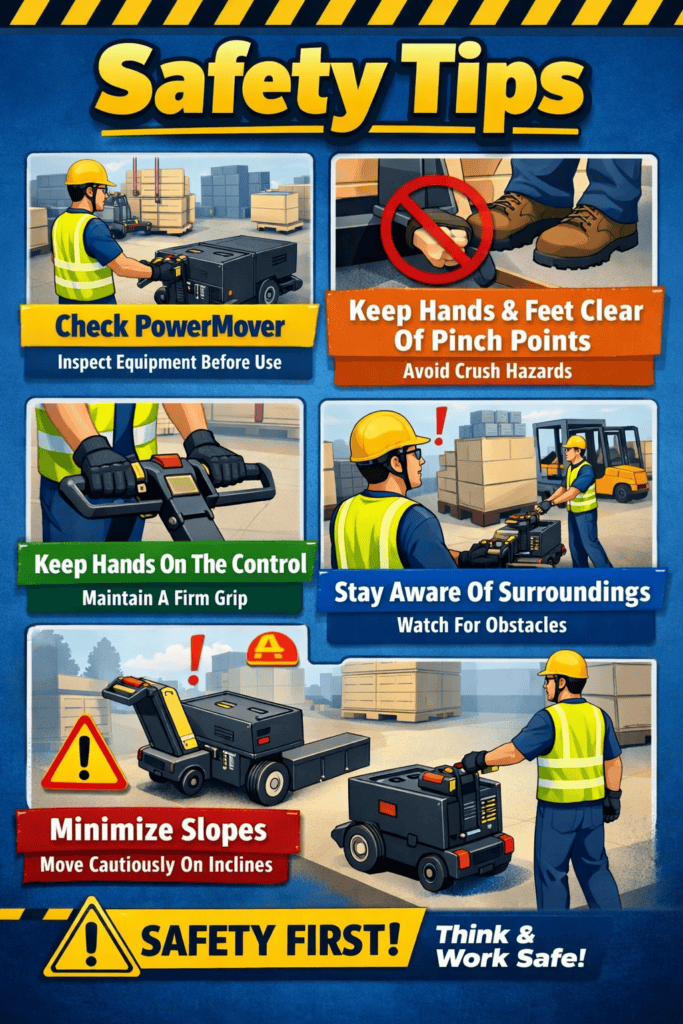
that person. Let the PowerMover do the lifting and aligning. Once the coupler is locked, give it a firm tug to confirm engagement. A secure connection is your best friend.
During operation, maintain a steady stance and keep both hands on the controls. The PowerMover delivers instant torque, so smooth throttle input is key. No sudden jerks, no dramatic lunges, and absolutely no “let’s see how fast this thing goes.” You’re maneuvering expensive inventory, not auditioning for a stunt show. Slow, controlled movement is safer, more professional, and frankly, more impressive.
Always stay aware of your surroundings. RV lots are full of blind corners, tight aisles, and customers who wander like they’re in a national park. Keep a clear path, communicate with your team, and use horn or strobe accessories when appropriate. These aren’t just upsell items—they’re legitimate safety tools that prevent collisions, confusion, and awkward conversations with management.
Avoid or minimize slopes whenever possible. The PowerMover can handle mild inclines, but gravity is undefeated. If you must operate on a slope, position yourself uphill, maintain traction, and move slowly. Never attempt sharp turns on an incline and never let the trailer roll freely. The PowerMover is a mover, not a brake substitute.
Finally, when the job is done, disconnect carefully, secure the trailer, and store the PowerMover in a clean, dry location. A well‑maintained unit is a safe unit—and a safe unit keeps your lot running smoothly.
Why Your Dealership Runs Better With a PowerMover—Period
A PowerMover turns chaotic mornings into controlled workflows. It replaces the need for tow vehicles, spotters, and risky maneuvers with a single operator who can position a 35‑foot trailer with the precision of a surgeon and the confidence of someone who knows they’re using the right equipment. When your team can move inventory faster, safer, and with fewer people, your entire dealership becomes more efficient. More efficiency means more sales
opportunities, more organized displays, and more time spent helping customers instead of wrestling trailers.
The Ultra‑Fab PowerMover isn’t an optional accessory for your dealership. It’s the modern standard. It’s the difference between “we’ll get that moved eventually” and “give me 30 seconds.” It’s the difference between a cluttered lot and a showroom‑ready display. It’s the difference between working harder and working smarter.
If you want a dealership that runs smoother, looks sharper, and operates safer, the PowerMover is the upgrade your lot has been waiting for. It’s time to bring one in and let your team experience what controlled, confident trailer movement really feels like.
Lock In Your PowerMover Mastery: Dealer Review Questions Ahead
Before you jump into the review questions, take a moment to appreciate just how much ground this training program covers. Ultra‑Fab PowerMovers aren’t just another accessory on the shelf—they’re a full‑blown dealership upgrade disguised as a compact machine. This article walked you through the pain points every RV dealer knows too well, from forklift‑induced jack carnage to the daily chaos of moving oversized trailers through undersized spaces. It showed how Ultra‑Fab solves those problems with precision, torque, reliability, and a level of control that makes even a 40‑foot fifth wheel feel cooperative. You learned how to operate the mover like a seasoned pro, and which upgrades turn a great tool into an unstoppable one. Now it’s time to lock in that knowledge. The following review questions will help reinforce the key concepts, operational details, and dealership‑specific advantages that make Ultra‑Fab the clear choice for professional trailer movement. Let’s see what stuck.

1) Why is using a forklift to move trailers discouraged?
A) Forklifts are too slow
B) Forklifts cannot lift trailers high enough
C) Forklifts are illegal for trailer movement
D) Forklifts lack precision and can damage jacks & trailers
2) Why are powered trailer movers increasingly necessary for RV dealerships?
A) RVs are becoming smaller
B) RVs are becoming lighter
C) RVs are bigger, heavier, and parked in tighter spaces
D) Customers prefer movers over tow vehicles
3) What major advantage do Ultra‑Fab PowerMovers have over tow vehicles?
A) They provide precision in tight spaces
B) They move faster
C) They use less fuel
D) They can tow on highways
4) Ultra‑Fab PowerMovers are compatible with which trailer types?
A) Only travel trailers
B) Only cargo trailers
C) Only fifth wheels
D) All major trailer types including goosenecks
5) What is the first step before powering up the mover?
A) Test the horn
B) Check the trailer lights
C) Inflate the tires
D) Ensure the unit is on level ground and aligned
6) Why is smooth throttle control important?
A) It saves battery life
B) It prevents sudden jumps and maintains control
C) It increases mover speed
D) It reduces tire wear
7) Why should slopes be avoided when possible?
A) Gravity increases risk and reduces control
B) The mover cannot climb slopes
C) Slopes drain the battery
D) Slopes damage tires
8) What is the proper stance during operation?
A) One hand on the throttle
B) Both hands on the controls with steady footing
C) Standing far away from the mover
D) Sitting on the trailer tongue
9) What is the benefit of foam‑filled tires?
A) They increase mover speed
B) They eliminate flats and improve durability
C) They reduce mover weight
D) They improve braking
10) What dealership‑wide benefit does the PowerMover provide?
A) More paperwork
B) More forklift usage
C) Faster, safer inventory movement and improved efficiency
D) Reduced trailer inventory
Answer Key:
Question 1 … Correct Answer: D
Question 2 … Correct Answer: C
Question 3 … Correct Answer: A
Question 4 … Correct Answer: D
Question 5 … Correct Answer: D
Question 6 … Correct Answer: B
Question 7 … Correct Answer: A
Question 8 … Correct Answer: B
Question 9 … Correct Answer: B
Question 10 … Correct Answer: C