
STOP RIGHT THERE: HOW TO STOP FASTER, SELL SMART AND AVOID ANGRY PHONE CALLS
Raymond Padgett
If you’ve ever stood at the parts counter listening to a customer explain that their “trailer brakes just stopped working for no reason,” you already know one universal truth: brakes and hubs don’t fail mysteriously-they fail because physics finally got tired of being ignored. And in the real world, physics is undefeated.
Trailer brakes, hubs, and wheel bearings are the quiet heroes of every road trip. They’re the only thing standing between a smooth, controlled stop… and a viral dash‑cam video titled “Florida Man Loses Control of their Trailer on I‑75.” Yet customers treat them like optional accessories – In most cases they forget they even exists, until they stop working.
That’s where you come in. You’re not just selling “parts.” You’re selling stopping power, safety, sanity, and – let’s be honest – a whole lot fewer angry warranty calls. When you understand trailer brakes and hubs at a deep level, you don’t just move inventory… you become the hero who keeps families safe, keeps rigs rolling, and keeps wheels attached to axles where they belong. Think what that does your customer loyalty.
So buckle up. This guide is your no‑nonsense, sell‑a‑lot masterclass on trailer brakes, hubs, drums, bearings, seals, and all the tiny parts that can ruin a trip faster than an overturned semi on I-20.
Some of what is in the training you may already know. We encourage you to read the entire thing, but you can skip forward to sections you feel a need to review. In this training we will cover:
· Customer pain points (Why do your customers feel the need for new brakes)
· What you should look for in quality brakes and hubs
· The right brake SKU can save a trip – and the wrong one can ruin your Google reviews
· What to Say When You Know They Need New Brakes or Hubs (Because sometimes the customer’s trailer is screaming for help – and you’re the translator.)
· Objection‑handling scripts (What you might say when they don’t believe they need new brakes, etc.)
· Upsell & Cross‑Sell Opportunities (Because every brake job is really three sales hiding inside one conversation.)
· What is available to help you sell more brakes, hubs, etc.
· Short quiz so you can check your knowledge.
Customer pain points (Why do your customers feel the need for new brakes)
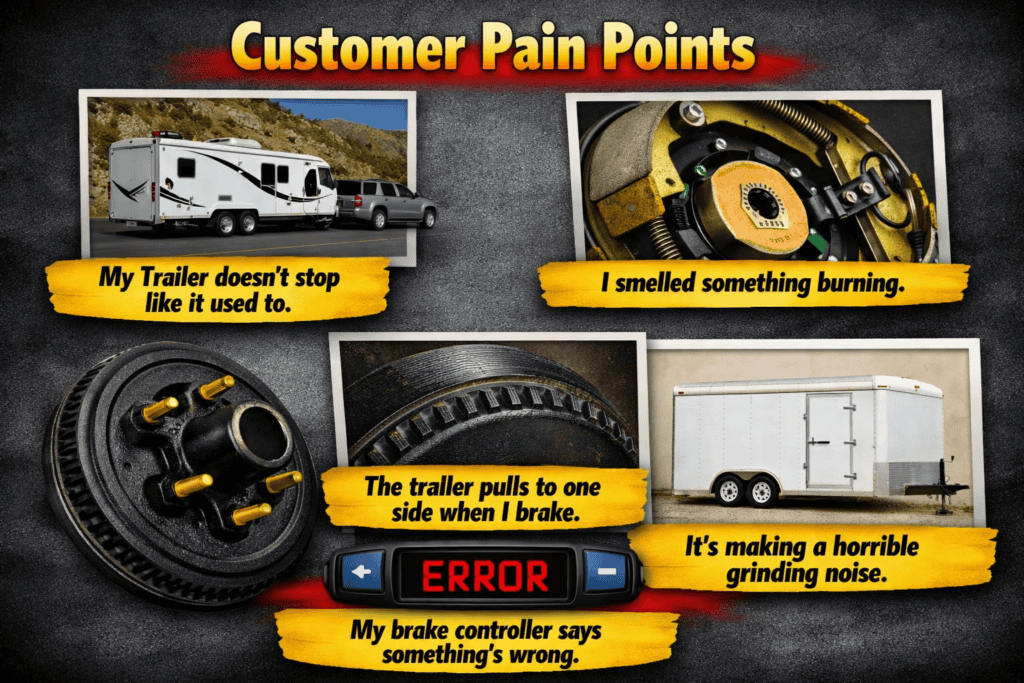
If you’ve been in the trailer world longer than seven minutes, you already know customers don’t wake up one morning thinking, “You know what? Today feels like a great day to invest in trailer brakes”. No – brakes only enter their consciousness when something feels wrong, smells wrong, sounds wrong, or nearly sends them into the back of a Walmart truck on I‑20.
Trailer owners don’t come looking for brake parts because they love maintenance. They come because their trailer has officially crossed the line from “trustworthy travel companion” to “rolling liability with a zip code.” And when that moment hits, they show up at your counter or website with the same energy as someone Googling symptoms at 2 a.m.
Let’s walk through some real reasons customers suddenly feel the urgent, burning, wallet‑twitching need for new trailer brakes – and why these moments are golden opportunities for dealers and online resellers.
Complaint 1: “My Trailer doesn’t stop like it used to.”
· Diagnosis: Classic brake fade, worn shoes, glazed drums, or brakes that were never adjusted correctly in the first place. Sometimes the brakes have been doing nothing for so long that the tow vehicle has been carrying the entire load like an overworked pack mule.
· Solution: Recommend a full brake inspection and replacement of worn assemblies. This is the perfect moment to upsell self‑adjusting electric drum brakes, which maintain performance and reduce future complaints. Remind them that replacing one brake is like replacing one sneaker – possible, but deeply unwise.
Complaint 2: “I smelled something burning.”
· Diagnosis: Overheated brakes, cooked bearings, or a hub that’s about to audition for a fireworks show. Burning smells are never good, unless you’re grilling.
· Solution: Immediate inspection of brakes, hubs, and bearings. Replace damaged drums, bearings, and seals. This is also a great time to recommend an annual brake & bearing service package so they never smell “hot metal and regret” again.

Complaint 3: “The trailer pulls to one side when I brake.”
· Diagnosis: Uneven braking caused by seized components, worn shoes on one side, or mismatched brake assemblies. The trailer isn’t “haunted” – it’s just trying to steer itself.
· Solution: Replace both brake assemblies as a matched pair. Explain that brakes work best in symmetrical, happy little couples. Offer complete left/right kits to ensure balanced braking and fewer future surprises.
Complaint 4: “It’s making a horrible grinding noise.”
· Diagnosis: Metal‑on‑metal contact. Shoes worn to nothing. Drums grooved like vinyl records. Bearings that have given up on life. This is the sound of money leaving their wallet.
· Solution: Full brake assembly replacement, new drums, and fresh bearings and seals. This is also a great opportunity to recommend premium bearings and high‑temp grease to prevent future grinding symphonies.
Complaint 5: “My brake controller says something’s wrong.”
· Diagnosis: Electrical issues – failed magnets, corroded wiring, bad grounds, or a dead short. When the dashboard tattles, it’s usually right.
· Solution: Test voltage at the magnets, inspect wiring, and replace worn magnets or entire brake assemblies. Offer wiring repair kits and upgraded connectors. For online resellers, this is where clear fitment charts and troubleshooting guides reduce returns.
What you should look for in quality brakes & hubs
Not all brakes and hubs are created equal. Some are built to stop a fully loaded fifth wheel on a downhill grade. Others are built to stop… well, hopes and dreams. And when your customers are towing a rolling condo full of pets, perishables, and questionable packing decisions, “good enough” is not good enough.
Whether you’re stocking shelves in a dealership or curating product pages for an online store, knowing what separates quality braking components from the bargain-bin disasters is the difference between happy customers and 2 a.m. warranty emails written in all caps.
Let’s break down what truly matters when evaluating brakes, hubs, bearings, and all the hardware that keeps trailers stopping straight, rolling smoothly, and staying attached to the tow vehicle.
Here are some things to look for when choosing brakes.
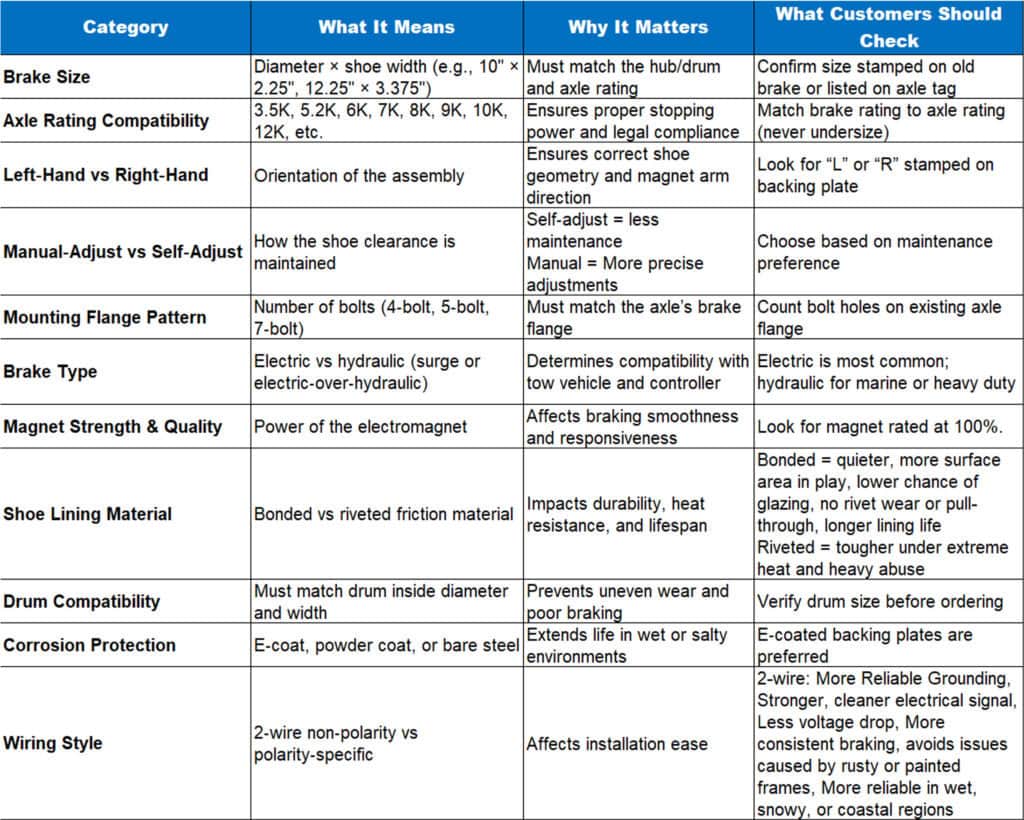
And a few to consider on hubs as well.
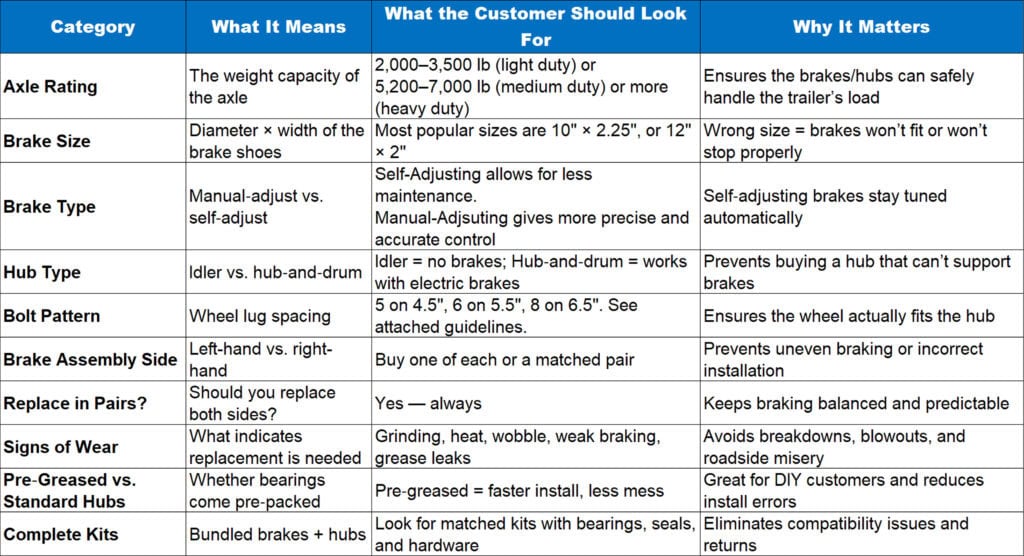
Brakes aren’t just brakes & hubs aren’t just hubs
One of the biggest challenges in the trailer parts world is that many customers – and even some new staff – assume brakes are brakes, hubs are hubs, and everything is interchangeable as long as it’s “round and metal.”
In reality, the differences between manual‑adjusting brakes, self‑adjusting brakes, standard hubs, idler hubs, and fully loaded hubs are massive. These differences affect stopping power, maintenance intervals, safety, longevity, and whether the customer ends up calling you from the side of I‑95 with a smoking wheel.
Understanding these categories isn’t optional – it’s the foundation of selling the right parts, preventing returns, and sounding like the expert your customers expect you to be.
Let’s break down each type to help with your customer conversations.
· Manual‑Adjusting Brakes: Brakes that must be manually adjusted using the star wheel to maintain proper shoe‑to‑drum clearance. Manual‑adjusting brakes are the “classic” electric drum brakes – simple, reliable, and still widely used across the trailer industry. But they require one thing customers are notoriously bad at: maintenance. That said, trailer customers (cargo trailers, landscape trailers, etc.) seem to prefer manual-adjusting brakes.
· Self‑Adjusting Brakes: Self‑adjusting brakes are the modern upgrade – the “set it and forget it” version of electric drum brakes. These brakes have an internal mechanism that automatically adjusts the shoes as they wear. Typically preferred by customers with RV trailers (Travel Trailers & Fifth Wheels) because they tow often, tow heavy, or simply don’t want to crawl under their trailer with a screwdriver every season.
· Idler Hubs: The simplest of all hubs – no drum, no braking surface, just a hub that spins freely. They are typically used on light trailers or boat trailers.
· Standard Hubs: Standard hubs are the basic building block of the trailer wheel system – the part that holds the bearings, supports the wheel, and keeps everything spinning smoothly. When buying standard hubs you’ll also need to sell bearings, races, nuts and other items.
· Fully Loaded Hubs (Hub/Drum Assemblies): The heavy hitters of the braking world. They combine the hub and the brake drum into one unit. They have integrated casting, designed to work with electric brakes. They include all the items needed to install and operate hubs.
As you can see, when the customers say, “I need brakes,” they could mean a number of different things. When you understand the differences, you can guide them to the right part the first time. And you look like the expert that can be trusted – not the parts clerk guessing in the dark.
Not all brakes are created equal, and some hubs belong in witness protection.
When customers shop for trailer brakes, hubs, bearings, and related components, they assume every brand is basically the same. “A brake is a brake,” they say, confidently, moments before buying the wrong bolt pattern, the wrong bearing set, or a brake assembly that was clearly manufactured in a shed behind a questionable gas station.
But you know better. The trailer braking world is a mix of premium engineering, solid mid‑range performers, budget options, and a few brands that should only be used if you’re building a trailer for your worst enemy.
Here’s the real breakdown of the major brands and models in the light‑ and medium‑duty trailer brake and hub world – who they are, what they’re known for, and how they differ in performance, quality, and customer satisfaction.
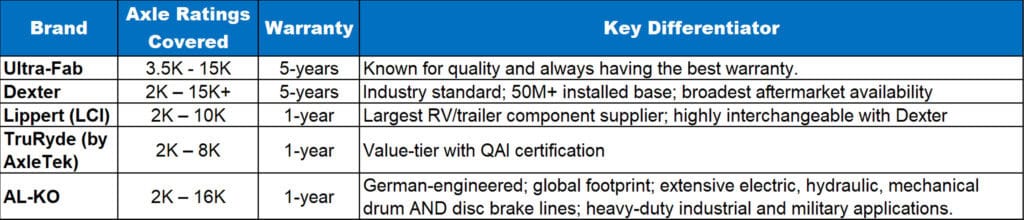
As you can see, Ultra-Fab and Dexter are the only companies that stand behind their products with a full 5-year warranty. You want that level of confidence in something as critical as your braking system.
Why warranties matter
Buying products with the longest warranty isn’t just about your customer’s peace of mind – it’s about protecting your reputation, and your sanity. A long warranty tells you the manufacturer actually believes in what they built, because companies don’t put multi‑year guarantees on products they expect to fail. It means fewer surprise expenses, fewer mid‑season breakdowns, and fewer “why is this happening to me” moments on the side of the road. When you choose the longest warranty available, you choose durability, confidence, and long‑term value – and you make sure that if something does go wrong, you’re not the one paying for it.
The right brake SKU can save a vacation – and the wrong one can ruin your Google reviews
When a customer walks in asking for “brakes for my trailer,” they think they’ve given you enough information. In fact, they’ve given you the trailer equivalent of walking into a pharmacy and saying, “I need medicine.”
If there’s one skill every dealer, service writer, and online parts reseller needs to master, it’s determining the correct brake size. Customers rarely know what they have. They’ll say things like, “It’s a standard trailer,” or “It’s got the normal brakes,” or the always‑helpful, “It’s the one with the wheels.”
Brake and hub sizes are not something you guess. It’s something you measure, verify, and match – because the wrong size doesn’t just cause returns. It causes comebacks, complaints, and the kind of customer emails that start with “I’m not usually the type to complain, BUT…”
Determining size is part detective work and part mechanical knowledge. Here is a simple guideline to help you determine the correct brake and/or hub.
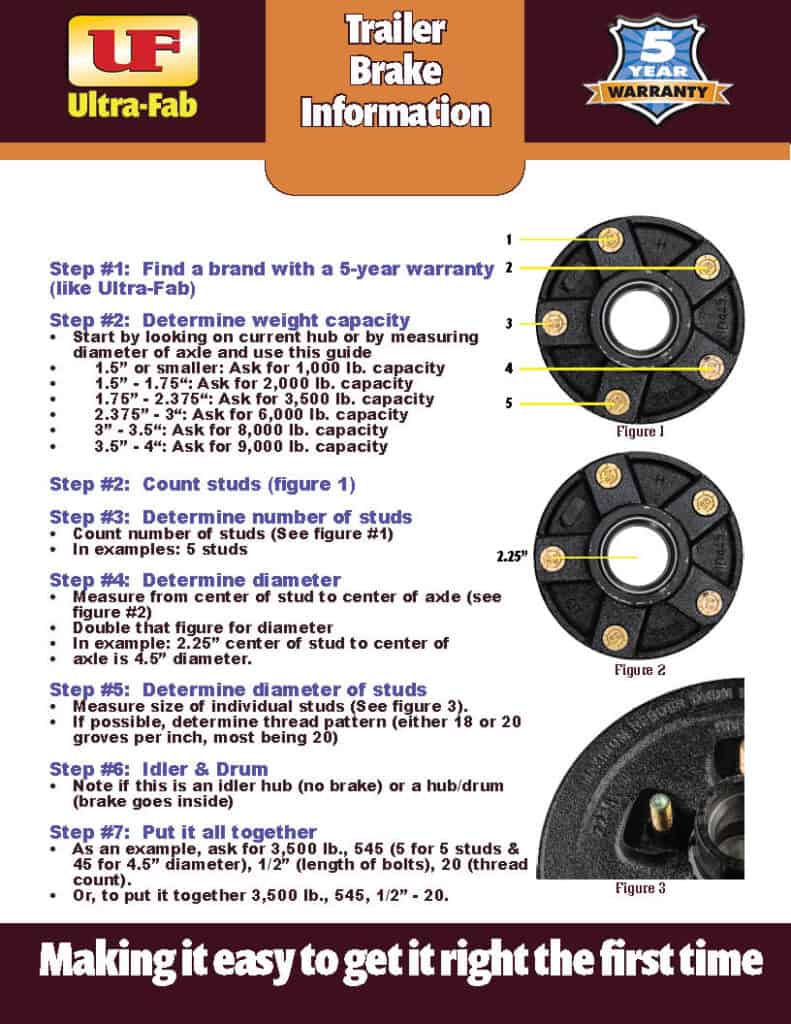
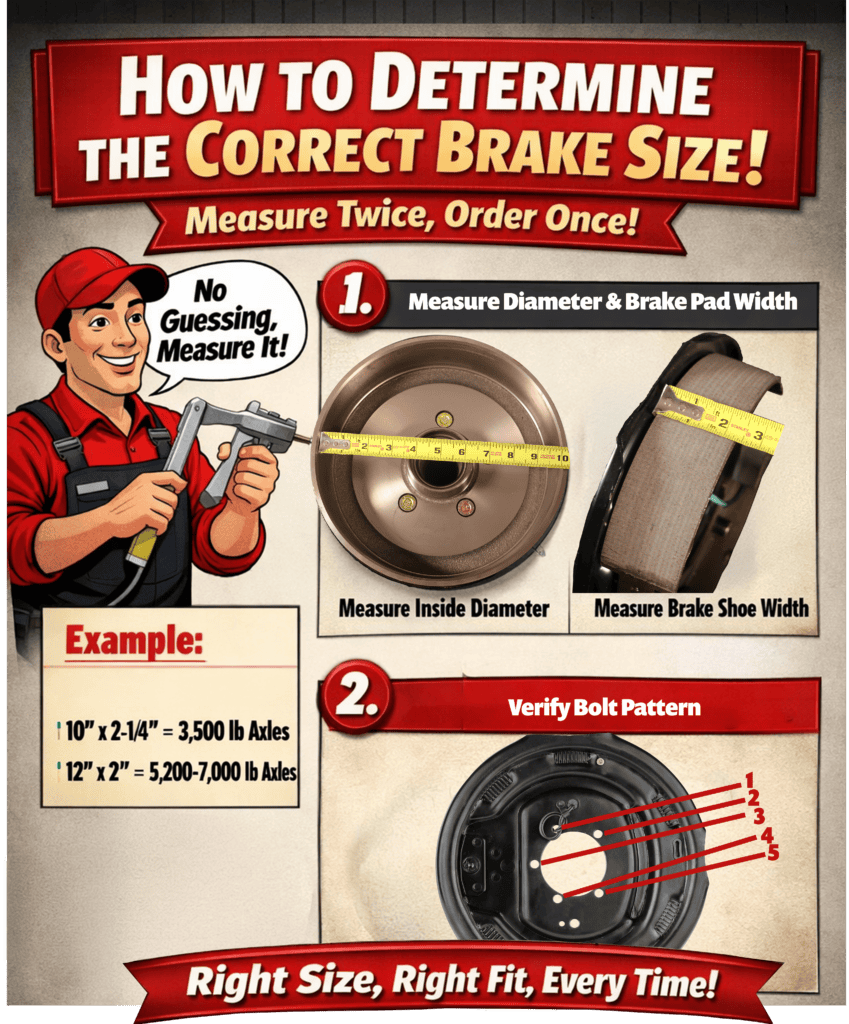
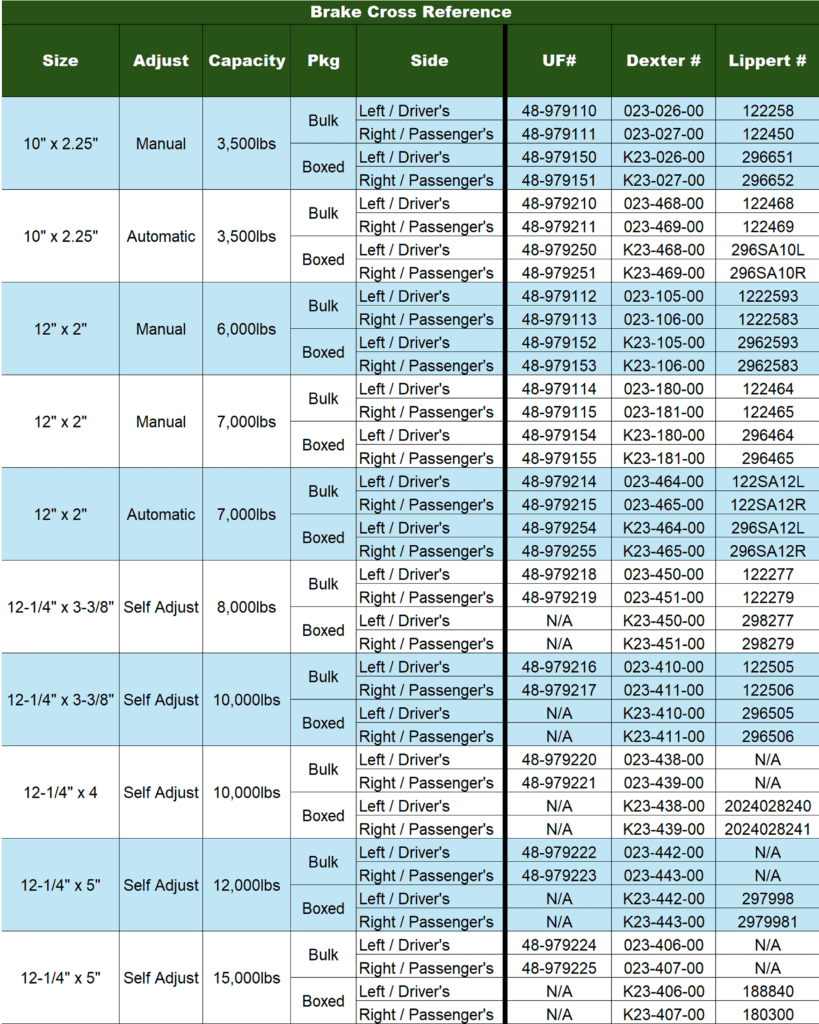
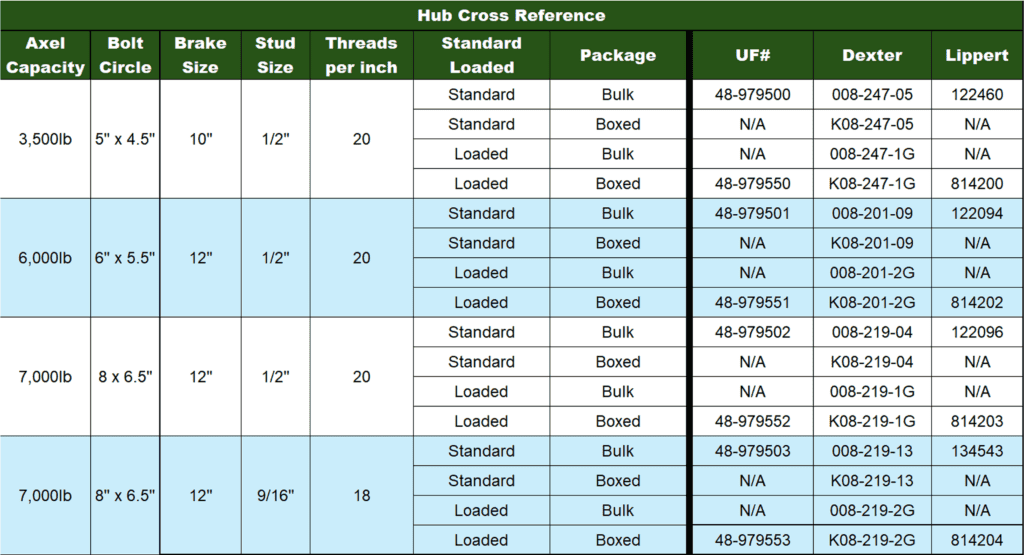
Cross Reference Charts
Often the best way to determine the size is to take part number on the old product and/or provided by the customer or technician and then cross it to other brands. Here are some common cross references.
Bundling for Better Sales and Customer Satisfaction
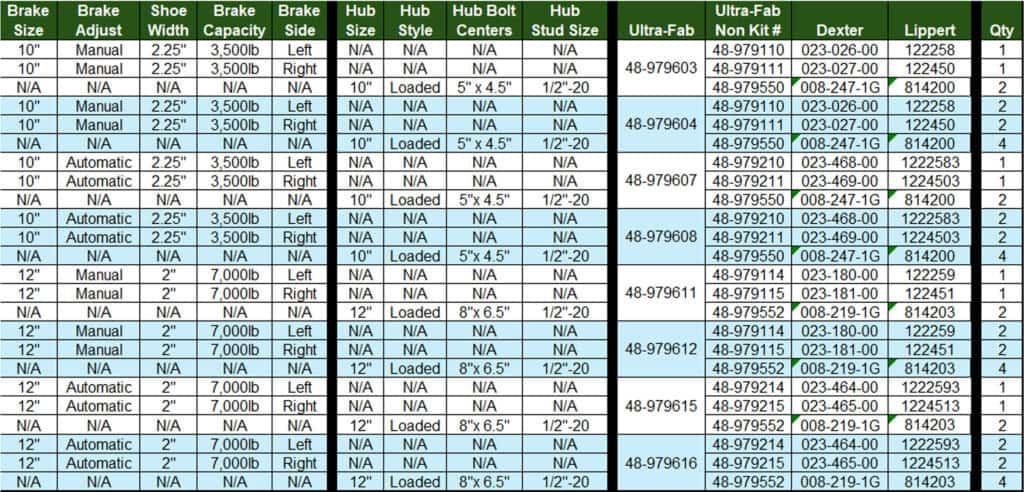
Its been mentioned that brakes and hubs should be replaced in pairs. You should refuse to only replace one brake or one hub. Doing the left and the right sides at the same time ensures even and consistent braking.
That’s why Ultra-Fab offers kits that include:
· One left side brake AND one right side brake
· Two left side brakes AND two right side brakes
· One left side brake, one right side brake AND two matching hubs
· Two left side brakes, two right side brakes AND four matching hubs.
Here is a chart that pulls all the information together:
What to say when you know they need new brakes or hubs (Because sometimes the customer’s trailer is screaming for help – and you’re the translator.)
Every trailer dealer and parts reseller knows the moment: the customer walks in holding a photo of something that used to resemble a brake or a hub. They’re frustrated, confused, and ready to spend money – but only if you can make them feel like they’re buying safety, not just parts.
That’s where a good script turns a problem into a solution, and a complaint into a confident purchase. There’s no need to memorize these, just get the idea down so you can help your customer see the need to make the right purchase.
· Scenario 1: The “It Doesn’t Stop Like It Used To” Customer
o Customer: “My trailer just doesn’t stop like it used to.”
o You: “Sounds like your brakes are doing more sightseeing than stopping. That’s usually a sign the shoes are worn or the magnets are tired. Let’s get you into a fresh set of brakes – they’ll give you smoother stops and save you from crawling under the trailer every season”.
o Dealer Tip: Trailer customers typically prefer self-adjusting brakes whereas customers will other types of trailers prefer manual-adjusting.
· Scenario 2: The “I Smelled Something Burning” Customer
o Customer: “I smelled something burning when I pulled into the campground.”
o You: “Good news – you caught it before it caught fire. That smell usually means overheated brakes or a bearing that’s auditioning for a horror movie. Let’s check your hubs and bearings. If they’re cooked, we’ll get you new assemblies and seals so your next trip smells like campfire, not catastrophe.”
o Dealer Tip: Humor disarms panic. Customers remember the laugh – and the solution.
· Scenario 3: The “It Pulls to One Side” Customer
o Customer: “When I brake, the trailer yanks to one side.”
o You: “One side’s doing all the work. We’ll replace both brake assemblies, so they’re balanced – like a good marriage. You’ll feel the difference the first time you stop.”
o Dealer Tip: Use analogies. They make technical explanations relatable and memorable.
· Scenario 4: The “It’s Making a Horrible Noise” Customer
o Customer: “It’s making a grinding noise – like metal on metal.”
o You: “That’s not music – that’s your brakes begging for retirement. When you hear grinding, it’s usually worn shoes or a bearing that’s given up on life. Let’s get you new brakes, drums, and bearings before that noise turns into a roadside repair.”
o Dealer Tip: Never say “you need everything replaced.” Say “let’s get you back to safe and smooth.” It feels proactive, not punitive.
· Scenario 5: The “My Brake Controller Says Error” Customer
o Customer: “My brake controller says ‘No Trailer Brakes.’”
o You: “That message means your controller’s not seeing the magnets – could be wiring corrosion or a failed magnet. We’ll test the voltage and get you new brake assemblies or magnets. Once it’s fixed, your controller will stop tattling.”
o Dealer Tip: Controllers are mysterious to most customers. Position yourself as the translator – not the technician.
What to say when they don’t believe they need new brakes or hubs (Because “They look fine to me” is not a valid diagnostic method.)
Every Trailer dealer and parts reseller has encountered a situation where the need to replace the brakes and/or hubs is obvious, but the customer doesn’t want to spend the money. Brakes and bearings hide behind wheels, so denial is easy – until something fails at 70 mph. Your job isn’t to argue; it’s to educate, reassure, and make the upgrade sound like common sense.
Here’s how to turn skepticism into sales – with humor, authority, and empathy.
· Objection 1: “I just replaced them a couple years ago.”
o Customer: “I replaced them two years ago – they should be fine.”
o You: “Two years sounds recent, but it’s not about time – it’s about miles, heat, and load. If you’ve towed through summer heat or mountain grades, those brakes have worked harder than you think. Let’s inspect them. Worst case, you get peace of mind. Best case, you catch wear before it costs you a drum.”
o Dealer Tip: Reframe inspection as value, not upsell. “Peace of mind” sells safety without pressure.
· Objection 2: “I don’t tow that often.
o Customer: “We only tow a few times a year.”
o You: “That’s actually when brakes fail most. Sitting still lets moisture and rust build up, and bearings dry out. It’s like leaving milk in the fridge for six months – it doesn’t matter that you didn’t drink it, it still goes bad. Let’s check your brakes and repack your bearings so your next trip starts safe.”
o Dealer Tip: Flip their logic. Infrequent use is not protection – it’s corrosion.
· Objection 3: “It’s just a little noise.”
o Customer: “It’s just a little squeak – probably nothing.”
o You: “‘Probably nothing’ is what every roadside repair starts with. Squeaks mean friction, friction means heat, and heat means wear. Let’s check it now while it’s a squeak – not a smoke signal.”
o Dealer Tip: Use escalation humor – it paints the risk vividly without fearmongering.
· Objection 4: “I’ll wait until next season.”
o Customer: “We’ll just do it next season.”
o You: “Totally understandable – but next season your bearings will have sat all winter, your grease will have separated, and your brake shoes will be one trip closer to metal‑on‑metal. Doing it now means you start next season ready to roll, not ready to repair.”
o Dealer Tip: Sell timing as convenience, not urgency.
· Objection 5: “I’m selling the trailer soon.”
o Customer: “We’re selling it soon – no point in spending money.”
o You: “Actually, fresh brakes and bearings make it sell faster and for more. Buyers love seeing maintenance records – it’s proof the trailer’s been cared for. You’ll get your money back in resale value, and you’ll avoid the awkward ‘brakes didn’t work right during test drive’ moment.”
o Dealer Tip: Tie maintenance to resale value – it reframes cost as investment.
· Objection 6: “I’ll just replace one side.”
o Customer: “I’ll just replace the bad side.”
o You: “Replacing one side is like changing one shoe – you’ll walk funny. Brakes work in pairs, and uneven braking causes pulling and premature wear. Doing both sides keeps your trailer stopping straight and saves you from replacing the other side next month.”
o Dealer Tip: You should refuse to change only one side.
· Objection 7: “I can get it cheaper online.”
o Customer: “I saw it cheaper online.”
o You: “Absolutely – there’s always someone selling parts cheaper. The question is whether they’re selling the right parts. We match your axle, verify fitment, and stand behind what we sell. Online sellers don’t answer the phone when your wheel falls off. We do.”
o Dealer Tip: Don’t bash online competitors – emphasize service, fitment, and support.
Customers don’t resist because they’re stubborn – they resist because they don’t understand the risk and/or they don’t understand the value. Your job is to make safety sound smart, not scary. End every objection with reassurance “Once we get these replaced, you’ll tow smoother, stop safer, and have one less thing to worry about.” That’s not pressure – that’s professionalism.
Upsell & Cross‑Sell Opportunities (Because every brake job is really three sales hiding inside one conversation.)
In the trailer world, brakes and hubs aren’t just parts – they’re the gateway to a bigger, safer, more profitable service ticket. When a customer needs brakes, they almost always need something else too. Not because you’re “selling them more stuff,” but because brakes never fail alone. They take friends with them. Bearings, seals, drums, wiring, breakaway switches – they all get dragged into the drama.
That’s why the best trailer dealers and online resellers don’t just replace what’s broken. They use the moment to build a safer trailer, happier customer, and a healthier bottom line. Upseling and cross-selling in this category isn’t being push – it’s preventative medicine. In fact,when you are upselling, you’re not “selling more”. You are:
· Preventing future failures
· Reducing roadside emergencies
· Improving stopping power
· Extending component life
· Protecting the customer’s investment
· Protecting your reputation
Upsells and cross‑sells in the brake/hub category are the most natural, logical, and customer‑friendly opportunities in the trailer world. Because at the end of the day, you’re not selling parts – you’re selling safety, confidence, and peace of mind.
Let’s break down the smartest, most natural upsell and cross‑sell opportunities that turn a simple brake sale into a complete, confidence‑building package.
· The Brake Assembly → Drum Upgrade
o When a customer needs new brake assemblies, it’s the perfect moment to look at their drums. Drums wear gradually, glaze over, groove, and warp – and customers never notice until you show them. Brake shoes seat better and last longer on fresh drums. Old drums reduce stopping power and accelerate wear.
o How to position it: “New shoes on an old drum wear out faster. Replacing the drum now gives you stronger braking and saves you from doing this job twice.” This is the easiest upsell in the entire braking universe.
· The Brake Job → Bearing & Seal Refresh
o If the hub is coming off anyway, this is a no‑brainer. Bearings and seals are cheap, critical, and often neglected. I can’t imagine replacing the hub without replacing the bearings and seals.
o How to position it: “Since we’re already in the hub, this is the perfect time to replace your bearings and seals. It adds a few minutes now and saves you hundreds later.” Customers love the logic – and the savings.
· Manual Brakes → Self‑Adjusting Brakes
o Self‑adjusting brakes maintain optimal shoe‑to‑drum clearance automatically. Customers hate maintenance. Self‑adjusting brakes reduce service intervals and improve performance.
o How to position it: “These brakes adjust themselves every time you stop. You get smoother braking and fewer service visits.” It sells itself.
· Brake Service → Breakaway Switch & Battery Check
o Breakaway systems are legally required – and often ignored. A dead breakaway battery means the trailer won’t stop if it detaches. You should check it with every brake and/or hub replacement.
o How to position it: “Your breakaway system is your last line of defense. Let’s test it and replace the battery if needed.” Safety sells itself.
· Bearing Service → High‑Temp Grease Upgrade
o This is the “premium oil change” of the trailer world. High‑temp grease handles heat better, lasts longer, and protects bearings under heavy loads.
o How to position it: “This grease runs cooler and protects your bearings longer – especially in the summer heat.” Regional relevance = instant credibility.
· Brake Replacement → Wheel & Tire Inspection
o Brakes don’t live in isolation – they live behind wheels and under weight. Uneven tire wear often indicates brake or bearing issues.
o How to position it: “Since we’re already here, let’s check your tires for uneven wear. It’s a quick check that can save you from a blowout.” Customers appreciate the proactive approach.
How Ultra-Fab helps you sell more (Because selling brakes isn’t just about parts)
Selling trailer brakes, hubs, bearings, and related components isn’t hard – once you have the right tools. The problem is that most resellers rely on tribal knowledge, half‑remembered axle charts, and whatever the last technician yelled across the shop.
But the truth is, there are powerful resources available that make selling brakes and hubs easier, faster, more profitable, and far more professional. These tools don’t just help you close more sales – they help you close better sales, with fewer returns, fewer comebacks, and far fewer “your parts ruined my vacation” emails.
Here’s what’s available to help you sell more – and sell smarter.
· Fitment Guides & Axle Charts
o Fitment guides are the single most important sales tool in the brake/hub world. They turn confusion into clarity and prevent 90% of returns. Customers rarely know their axle rating, bearing numbers, or brake size. Fitment guides give your team a fast, authoritative way to match the right SKU to the right trailer. They reduce uncertainty, speed up the sales process, build customer confidence, prevent wrong‑part returns and make your staff look like geniuses. A good fitment guide is basically a cheat code.
· Bundled Kits (Brake + Drum + Bearings + Seals)
o Bundles are the king of cross‑selling. Customers don’t know what they need. Bundles remove the guesswork. This leads to higher average order values, fewer missing‑part returns and happier customers. Bundles turn a $60 brake sale into a $200 kit sale – and customers thank you for it.
· In‑Store Displays
o Displays are critical as they act as the silent salespeople in your showroom. Customers love touching, comparing, and seeing the difference between products. That’s why Ultra-Fab provides a display stand for brakes and/or hubs to help customers understand what they are buying. They help increase impulse purchases, educate customers visually and make your store look professional. Ultra-fab provides a display to you are no charge when you purchase 6 brakes or hubs.
Final thoughts
At the end of the day, brakes and hubs aren’t just another SKU on your shelf – they’re the difference between a happy customer who comes back for accessories… and a furious customer who comes back on a tow truck. And that’s exactly why Ultra‑Fab exists.
Ultra‑Fab brakes and hubs are built for dealers who are tired of comebacks, tired of inconsistent quality, and tired of explaining why a “brand‑name” part failed after one season. With Ultra‑Fab, you get stronger magnets, better machining, cleaner castings, tighter tolerances, and packaging that doesn’t look like it survived a bar fight. You get parts that install clean, perform consistently, and keep your customers safe – which keeps you looking like the hero.
And let’s be honest: your reputation is worth more than saving five bucks on a bargain‑bin brake assembly.
When you stock Ultra‑Fab, you’re not just adding another brand. You’re adding fewer returns, fewer headaches, fewer warranty calls, and more loyal customers who trust your recommendations because they work the first time.
So load your shelves with Ultra‑Fab brakes and hubs. Give your customers the quality they expect – and give yourself the peace of mind you deserve.
Ultra‑Fab: Better parts. Better margins. Better outcomes. Stop the problems before they start – and start selling the brand built to make you look good.
Review Questions
1) What is the primary difference between manual‑adjusting brakes and self‑adjusting brakes?
A. The color of the backing plate
B. Self‑adjusting brakes automatically maintain brake pad contact
C. Manual brakes stop harder
D. Self‑adjusting brakes require more maintenance
2) What measurement determines the correct brake size for a trailer?
A. Outside diameter of the wheel
B. Length of the axle
C. Bolt pattern only
D. Inside diameter and shoe width of the drum
3) Which hub type should be used on an axle that does NOT have brakes?
A. Idler hub
B. Hub/drum
C. Fully loaded hub
D. Disc hub
4) What is the main advantage of using Ultra‑Fab self‑adjusting brake assemblies?
A. They are cheaper than all competitors
B. They eliminate the need for periodic manual adjustments
C. They only work on new trailers
D. They require special tools to install
5) Why is matching the correct bolt pattern important when selecting a replacement hub?
A. It affects fuel economy
B. They eliminate the need for periodic manual adjustmentsIt ensures the wheel mounts safely and evenly
C. It makes the trailer quieter
D. It improves brake controller performance
6) What is the most common cause of brake fade on electric drum brakes?
A. Cold weather
B. Over‑greasing
C. Heat buildup from worn or improperly adjusted brakes
D. Using aluminum wheels
7) Why is it recommended to replace hubs/drums when installing new brake assemblies?
A. New drums look nicer
B. Old drums may be grooved, glazed, or out of round
C. It’s required by law
D. It makes the trailer lighter
8) What does a burning smell from a trailer wheel typically indicate?
A. Normal operation
B. Tire pressure is too high
C. The breakaway switch is activated
D. Overheated brakes or failing bearings
9) What is the most common cause of uneven braking between the left and right sides of a trailer?
A. One brake assembly is worn or out of adjustment
B. Tire brand mismatch
C. The trailer is too light
D. The tow vehicle is too powerful
20) Why should brake assemblies always be replaced in pairs (left & right)?
A. It’s cheaper to buy two
B. It keeps braking balanced and prevents pulling
C. It’s required by axle manufacturers
D. It makes the trailer quieter
Answer Key
1. B – Self‑adjusting brakes automatically maintain brake pad contact.
2. D – Inside diameter and shoe width of the drum.
3. A – Idler hub.
4. B – They eliminate the need for periodic manual adjustments.
5. B – It ensures the wheel mounts safely and evenly
6. C – Heat buildup from worn or improperly adjusted brakes.
7. B – Old drums may be grooved, glazed, or out of round.
8. D – Overheated brakes or failing bearings.
9. A – One brake assembly is worn or out of adjustment
20. B – It keeps braking balanced and prevents pulling.